


It’s now two and a half weeks since my shoulder surgery, and I’ve been reflecting on how the people around me have been showing up. In some ways, it’s been pretty overwhelming. My birthday party a few weeks ago showed me I have some really fantastic, amazing people in my world. I didn’t make a big song and dance about the forthcoming surgery, no big posts on social media about going into hospital, although if I was talking to somebody and they asked how my shoulder was, I did let them know that the work was about to be done.
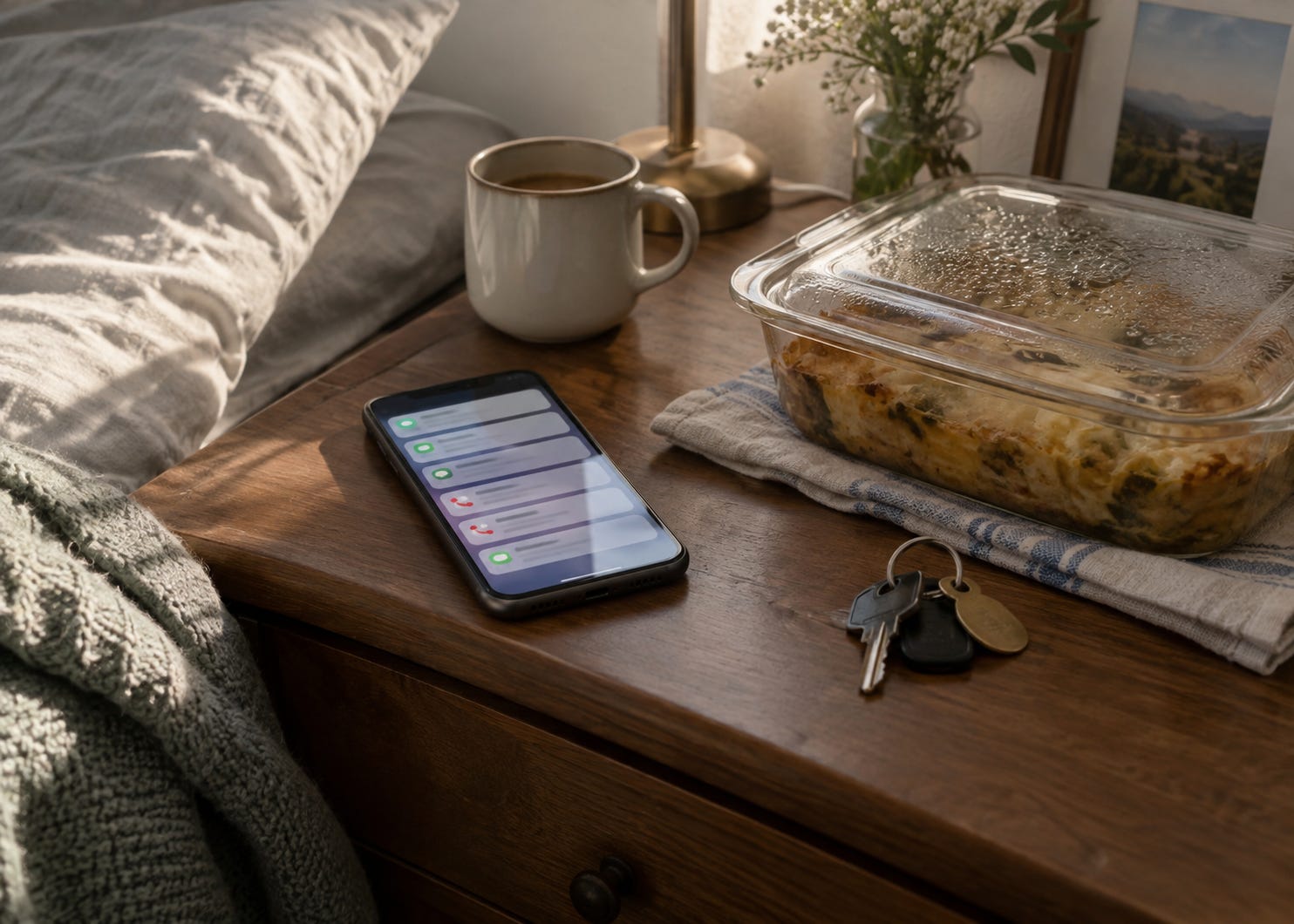
Since coming home, I’ve had a constant stream of check-ins from people I know, touching base, asking how everything was going, offering to help if I need it. I’m really grateful to all of those people for taking the time.
Some of those people have been amazing in how they’ve rearranged their days to lend a hand. It’s highlighted how strong my connections with them are. I wrote about the mechanics of connection before, in Building Authentic Connections: curiosity, listening, being willing to show the unpolished parts of yourself.
“Connection is why we are here; it is the purpose and meaning underpinning our lives. As we invest in genuine connections, we are building wellbeing not just for ourselves, but for those around us. For those of us who have experienced long-term loneliness, this is beyond precious. By creating authentic connections, we are building a community around us.”
The first couple of weeks after my shoulder surgery have taught me how it’s not what someone says when things are fine, but what they’re willing to do when they aren’t. The other day I wrote about What Happens When You Actually Let People Take Care of You, and the detail that stayed with me wasn’t the surgery. It was what my friends did about it.
“They’ve even created a roster to make sure that at least for the first week or so, somebody is with me regularly, staying over at night, keeping me company.”
Nobody asked them to build a roster. They just did - there was clearly a bunch of WhatsApp messages flying around, none of which I was privy to, nor needed to be. That’s a weird experience for me; it’s not so much that I micromanage, but the idea that things are being organised for me in the background without me needing to contribute is quite novel.
This is the same group of friends who a few weeks ago ran my 60th birthday party, a story I told in my piece Could I Actually Let My Friends Throw My Own Party? Neither time did anyone really ask permission first; they just told me to butt out and not worry!
“They made it clear to me that it was all under control, so even when I asked a few questions, they pushed back: “Leave it to us.” I think I surprised them - and very definitely myself - how easily I acquiesced. What made the difference is that I trusted them completely, and that’s another very new experience for me.”
If you've ever caught yourself weighing up who really showed up for you, in whatever form that took, I'd like to hear about it. I write about solitude, connection and the quieter parts of being a good human most weeks. Subscribe to get the next one.
Simone Weil wrote to a bedridden friend about exactly this kind of gift.
“Attention is the rarest and purest form of generosity.”
There’s an idea that different types of action send different types of signals, and each signal has a cost; sending a text message is low-cost for the sender. For two or three people to work together and create a roster to care for a friend who has just come out of hospital is highly costly. Evolutionary psychologists have a colder name for this idea: ‘a costly signal’, one whose worth lies in what it costs to send rather than in what it says.
But I’m not quite sure I agree with this idea of cost. The reality is that many of the people who were sending me messages and texts aren’t even in Melbourne; their capacity to offer practical assistance is very limited. I don’t see why I should judge them differently from those people who did come over to my house to help me with the things that I’ve been struggling with while my shoulder is recovering. I’m grateful they took the time to reach out and show love and care for me, even from a distance.
Authenticity is about showing up - but showing up can take many different forms. What matters is that people show up unselfishly, whatever the method or mode. Sherry Turkle has said:
“We expect more from technology and less from each other.”
While I probably agree with her generally, one of the joys of technology today is how it can keep us connected. For example, one of my best friends is in Europe at the moment; she’s been concerned about my surgery, offering her advice and perspective, and I’m very grateful to her for that. She’ll be back in Melbourne in a few weeks, and I’m really looking forward to catching up. I don’t devalue the fact that she is not here physically, because she is with me in spirit.
Authenticity gets talked about as though it’s a feeling, something you either have with someone or don’t. I think some people see authenticity as a record of what people have done when it was inconvenient for them, and there is truth in that, but I think it’s much wider than that, because the idea that a whole group of people have been messaging, checking in with me, ringing me and otherwise, in various ways, showing their support and care has meant the world to me.
DO YOURSELF A FAVOUR
That was Molly Meldrum’s line, and it still holds up. You’re reading Alone Rangers for free, that’s not changing. But a paid subscription keeps it free for everyone else and puts a few dollars behind work that’s trying to say something true about loneliness and connection.