


When my partner and I separated, the people around me sorted themselves into two groups without anyone announcing it. The dads I had stood beside on freezing sports pitches for years never contacted me again. I have written about that silence before, including my own share of it, because I never contacted them either. None of those men did anything wrong. They were good people who were never quite my friends, and I had not noticed the difference until the moment I needed it.
A while back I put together Ten Qualities of a Good Human, and it still finds more new readers through search than anything else I have written. The qualities on that list- kindness, honesty, generosity and the rest - are the entry price for being worth knowing, but you can hold every one of them and still be nobody’s friend. A good person will wish you well from a distance, while a good friend knows how you are actually travelling this week, and the gap between those two is where a lot of men end up lonely.
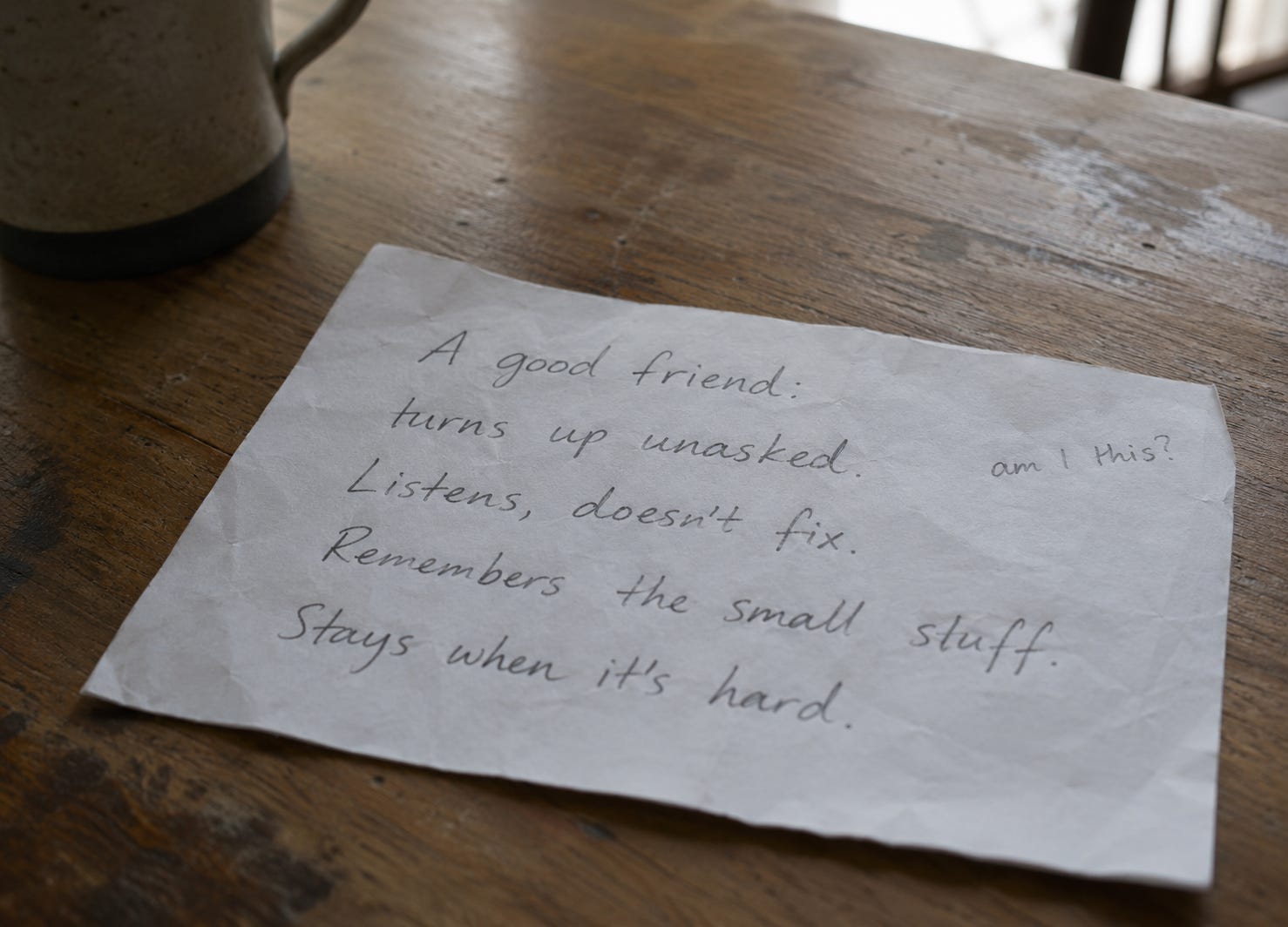
Search for the traits of a good friend, and you will find lists of virtues: loyalty, trust, empathy, that could just as comfortably describe a reliable colleague or a well-trained kelpie. What makes a good friend is more specific than character, because mostly it is not character at all but behaviour, things a person does for you in particular, over time, without being asked.
Consistency comes first. The evolutionary psychologist Robin Dunbar, who has spent decades studying why some relationships endure, and others quietly dissolve, describes the handful of people at the centre of our lives like this.
“They are what I call the ‘shoulders to cry on’ friends, the people who will drop everything and come to your aid when your world falls apart.”
Nobody gets into that inner circle by accident, and his research puts the reason bluntly.
“People’s willingness to do that depends primarily on the time you invest in them.”
The friend who texts to see how the week went or suggests a walk or a beer without a reason attached is doing the slow work that every other quality depends on.
Listening comes next, and it is harder than it sounds. Most men I know, me included, are more comfortable doing than talking, so when a friend brings us something heavy, our reflex is to reach for solutions before he has finished describing the problem. A good friend can sit with the mess for a while, ask a question or two, and trust that being heard is most of what was wanted. The same patience shows up in smaller ways, in remembering the interview you mentioned or the scan you were waiting on, and asking how it went without needing a reminder.
Then there is staying close when things get hard. Anyone can be good company at a barbecue. The characteristics of a good friend only really show themselves in the stretches nobody would choose, the separation, the redundancy, the diagnosis, when turning up gets awkward, and most people politely disappear. The psychologist Marisa Franco, whose book Platonic gathers the research on adult friendship, points at what is at stake in those moments.
“Scientists have found that of 106 factors that influence depression, having someone to confide in is the strongest preventor.”
One person you can confide in does more for your health than a suburb full of pleasant acquaintances, which is worth remembering in a culture that still tells men to carry things alone.
The uncomfortable part of a list like this is that it reads in both directions. I stood next to those sports dads for years and never asked a single one of them how he was actually doing, so the silence after my separation should not have surprised me. I had offered them exactly what they offered me.
If you want somewhere to start, pick one person, remember one small thing they told you last time, and ask them about it this week. It costs a text message. That, repeated, is most of what makes a good friend.
Read more like this
Why Is It So Hard to Make Friends as an Adult?
Ghosting, Fading, and the Unfinished Endings of Modern Friendship