


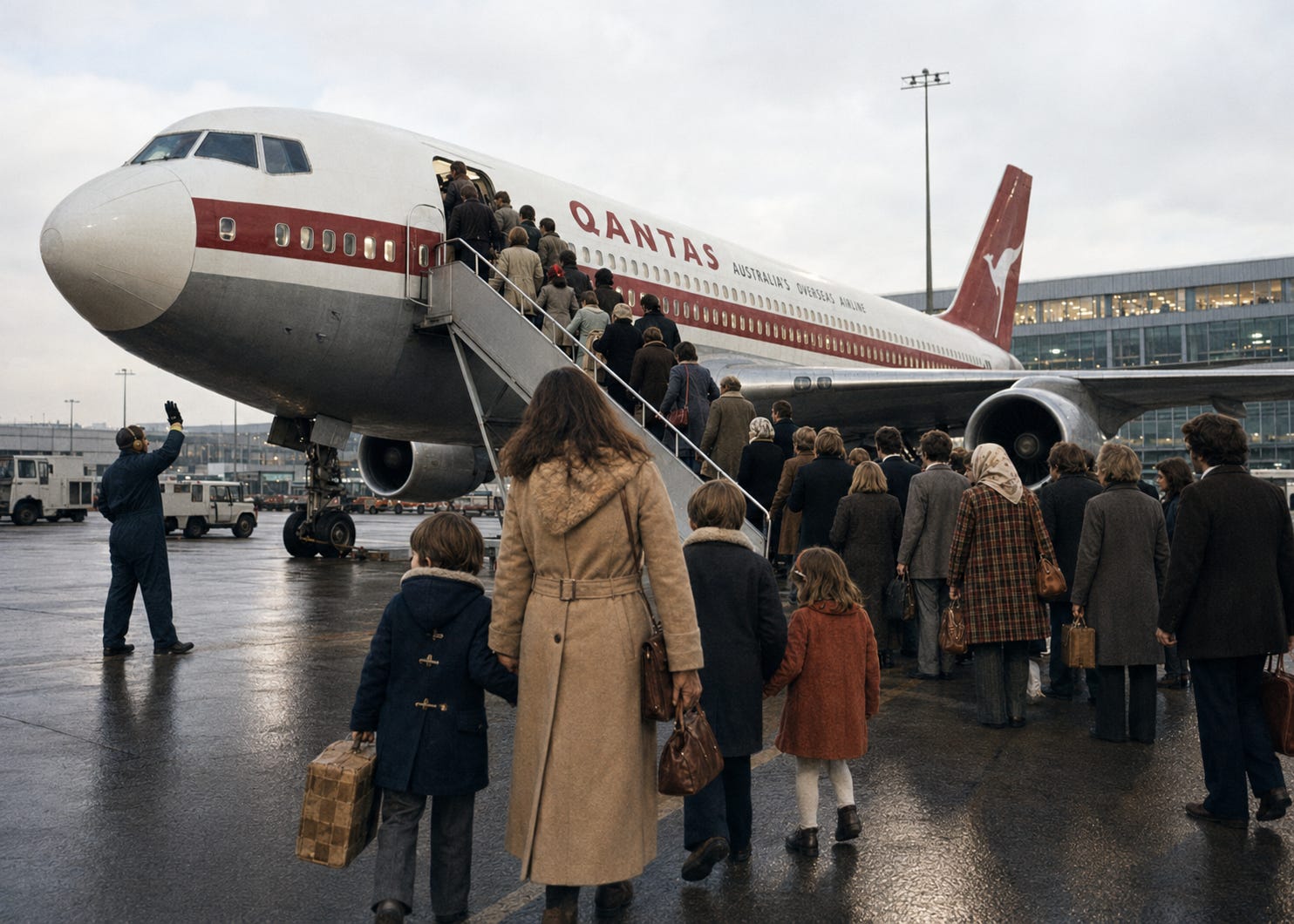
On Christmas Eve 1975, our mother walked three of us kids onto a Qantas jumbo at Heathrow, bound for Darwin. I was nine, and my eldest brother, already a year into Cambridge, stayed behind in England while the rest of the family started again on the other side of the planet.
By the time my schooling finished 12 years later, I’d been a pupil at seven schools across two countries: two in England before that flight, a school in Darwin, a boarding school in the English Midlands from age eleven (yup, commuting on Qantas each term from Darwin), a few more years at school in Darwin, then two final years boarding in Geelong (more commuting for the holidays).
At our English boarding school, we were the Australian curiosities - I do recall failing a test because I couldn’t name the capitals of all the Australian states - but in demand for the swimming team.
Because English school terms didn’t align with the Australian ones, I remember being accosted by an adult on the streets of Darwin, who demanded to know why we were not in school.
We even made the local newspaper, the NT News - Director of Education thinks so much of his schools that he sends his own children to school in England. It’s a News Ltd paper; you can get the drift.
In the tropics, we were the pommy kids. In the cold English Midlands, the antipodean curiosities.
Today, if I visit England, everyone thinks I’m from New Zealand. Despite 50 years in Australia, people still ask where my accent is from - not quite Australian, not quite English. However, they’ll tease me about my pronunciation of words like ‘vitamin’ and ‘plastic’.
There’s a price to pay for the peripatetic schooling. Friendships made at one school dissolved the moment I changed schools, in an era when staying in touch meant a weekly aerogram rather than a phone in your pocket. I’ve written before about the loneliness of an intercontinental childhood, and about realising at 54 that I’d been lonely my whole life.
What I hadn’t reckoned with back then is what that arithmetic does as you close in on 60. Friends who stayed in one town are forty or fifty years into the same friendships. I have friends today who are still in touch with their school friends.
My friendships kept resetting without my consent.
Mine Ruth Van Reken, who spent decades studying what she and the late David Pollock named the third culture kid experience, names the cost plainly.
“Identity becomes a real question. Where am I from? Who am I? Where do I belong?”
She’s talking about kids, but I’m fifty-nine and still don’t have a tidy answer, which gets a bit harder to admit at a barbecue full of people who’ve known each other since primary school.
I do wince when people ask me, ‘Where are you from?’ What they mean is, were you born in Melbourne, or Adelaide, or Sydney? It’s when I draw a deep breath and try to decide whether to inflict the entire saga (West Africa > England > Darwin > Alice Springs > Ballarat > Sydney > Bendigo > Melbourne) or just whether “oh, I moved here from England as a kid”!
Psychologist Pauline Boss calls it ambiguous loss, grief with no body, no divorce, no tombstone with a date carved into it:
“Ambiguous loss makes us feel incompetent. It erodes our sense of mastery and destroys our belief in the world as a fair, orderly, and manageable place.”
Nobody died, and nothing was officially lost, yet there’s no single town, accent, or group of mates from age ten who can vouch for who you were before you became whoever you are now. Perhaps some people might welcome this, the opportunity to create their own story and embellishments. But there’s so much influence early life has on your identity.
Turning 60 in a couple of months has made it harder to wave off. I’ve celebrated in articles previously how glad I am that our kids have enjoyed stability throughout their schooling - living in the same area, attending only a couple of schools each - and how they are still in touch with friends from primary school as they move into their late 20s.
To some degree, I’m now seeking that same grounded stability, evaluating where and how I’d like to live in the coming years and the people I’d like around me. Maybe I’m looking to recreate the same certainty our children have enjoyed. So what if it’s a few decades late? It doesn’t undo my history, but my past is just that, history. Like all of us, it’s my journey, and I’m grateful today I can choose what’s next.