


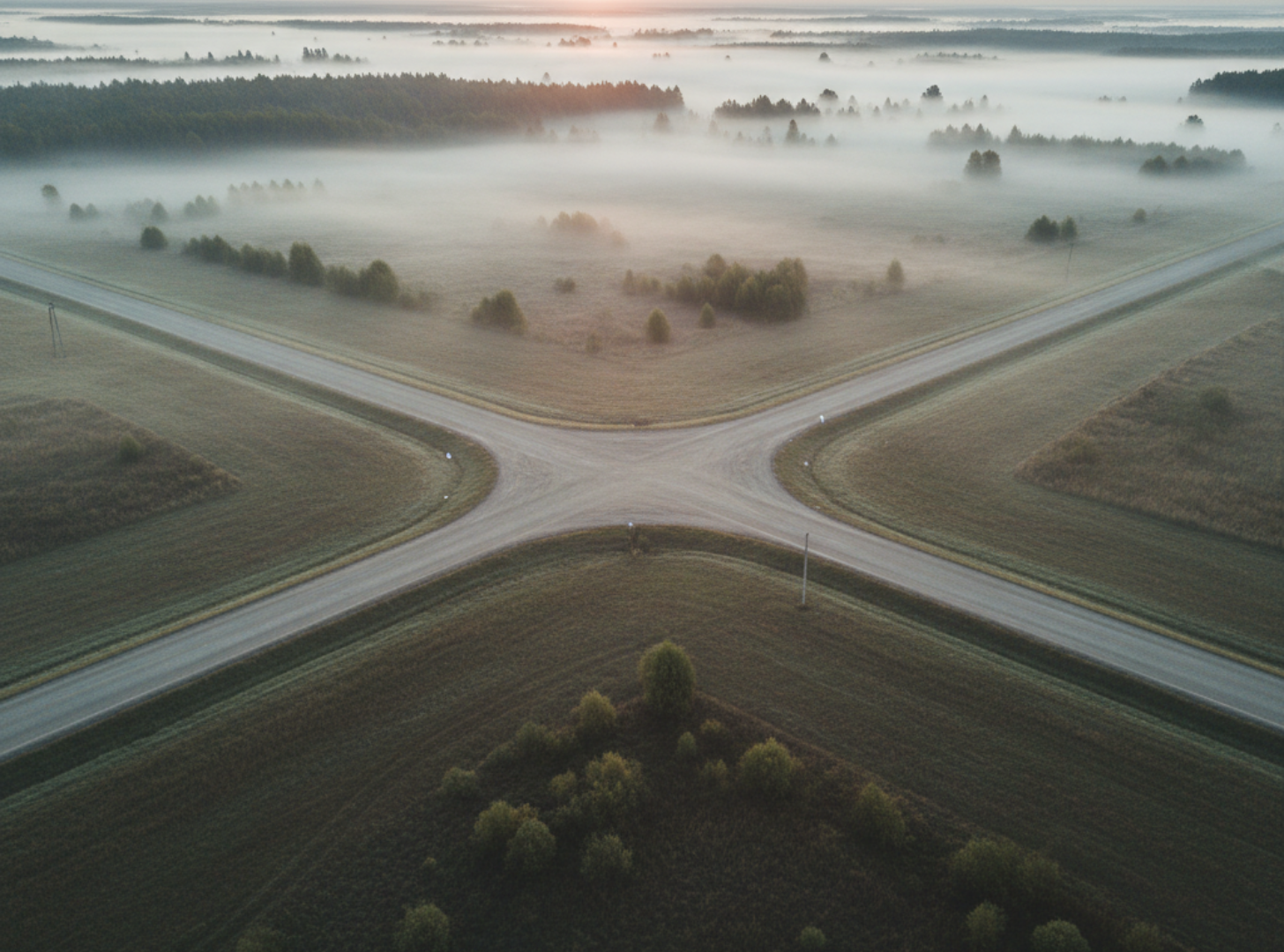
We have all sat at a crossroads pondering a decision, whether in life or at work. We consider what we know about the choices, maybe we want some more data, more advice, another perspective to help us choose a path.
Some of us are more impulsive than others - I’ve done an executive profiling exercise for work that shows I don’t need much data to make a decision. In my work life, I tend to make decisions quickly; it’s a combination of natural impatience, time scarcity, and pressure from my team to be the ‘solver’.
I don’t pore over a spreadsheet for hours. I look at the summary, try to see the bigger picture, and move on whatever impulse surfaces. And of course, that’s not always going to prove the right decision, but I’d rather keep the forward momentum than become bogged down in the mire of indecisiveness.
But I also worry about consequences. Too often, we pause too long at the crossroads because we’re concerned about the uncertainty of what will happen.
Annie Duke, former professional poker player and author of Thinking in Bets, puts it plainly:
“What makes a great decision is not that it has a great outcome. A great decision is the result of a good process.”
The trap she calls “resulting” is the reverse: judging a decision entirely by what happens next. If things go well, we assume we made a great choice. If they go poorly, we berate ourselves. The latter is what has me awake at 2 a.m., churning over the outcome.
That 2 am spiral is its own kind of punishment. As I wrote in Speaking Kindness to the Mirror (check out the photo!), the harshest critic in the room is usually the one living rent-free inside our own head.
Let’s take a reality check. None of us can see the future. We might make a decision, but there may be hidden information, an element of luck or external forces that, even if our decision seems sound, may still all fall apart. Alternatively, a shitty, reckless decision may pay off through sheer luck.
We’re trying to buy an insurance policy that doesn’t exist. We research and consider our decision - and in some instances procrastinate - to allay our fears.
Psychologists refer to this as Intolerance of Uncertainty. For many of us, the brain treats an unknown future as a physical threat. I stay awake at night not because the options are equal, but because I am trying to solve for a future I cannot yet see.
You can’t control what happens next. You can only control how you made the call. Those are two very different things, and conflating them is where the 2am spiral starts.
We might ask ourselves: Did I act in accordance with my values? Did I look at the facts honestly? Did I treat people well in the process?
If the answer is yes, then the decision was a good one, regardless of whether the clouds cleared or the rain fell. We cannot control the wind, but we can be certain about how we set the sail.
I explored this in The Quiet Strength of Being Unsure - the goal isn’t to become more certain:
“When we stop chasing the illusion of certainty, we become more honest team members and more reliable friends. We stop pretending to have all the answers and start showing up with the quiet assurance that, whatever happens, we can figure it out together.”
No one gets it right every time. The question isn’t whether you’ll make a perfect call. It’s about making a decent one and then letting it go.
How much of what’s eating at you right now is the choice itself? And how much is just the waiting?