


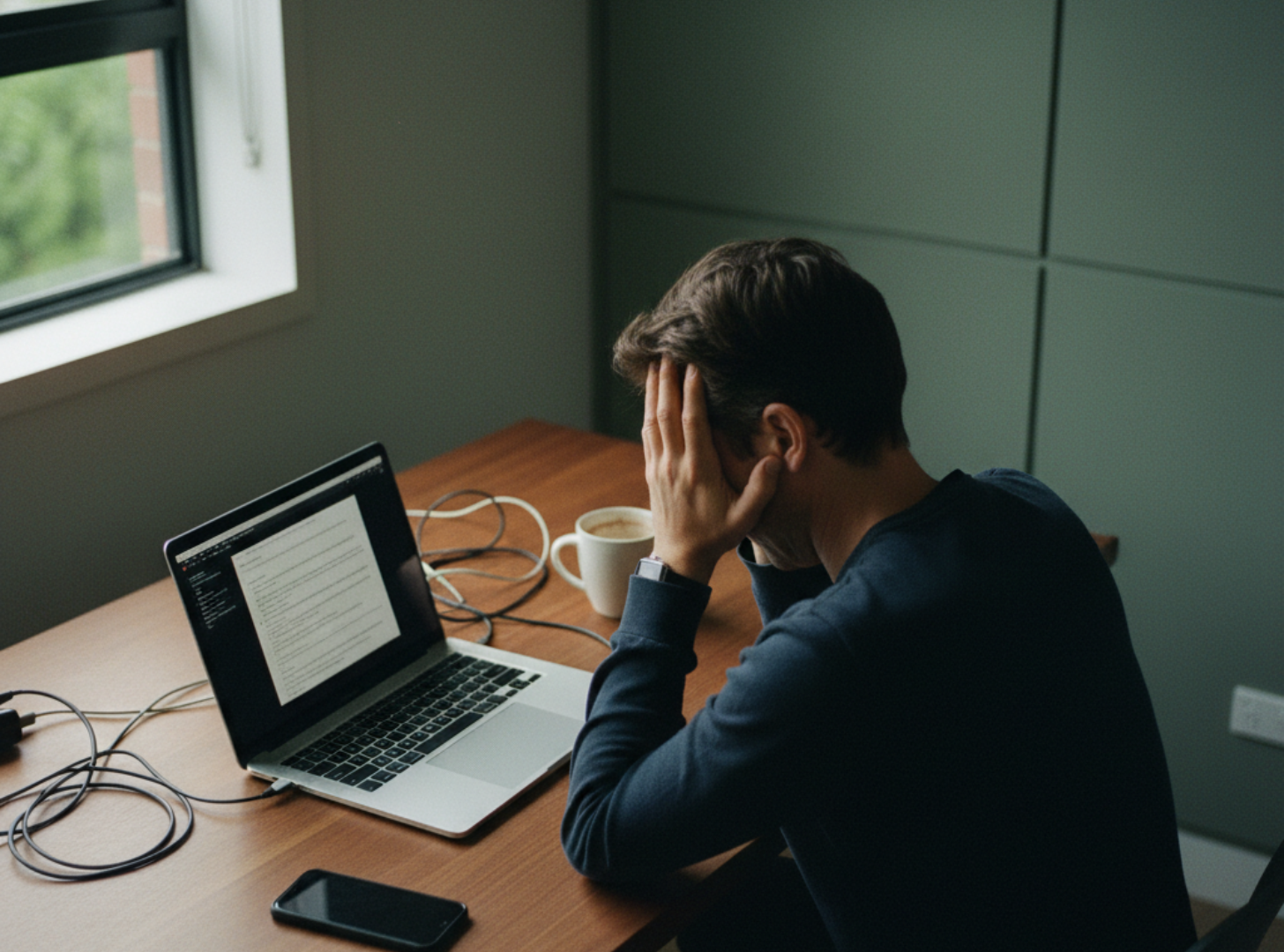
We have all had ‘for fucks sake’ moments. Have you tried to use a chatbot on your bank’s website recently? I’m currently engaged in an ongoing battle to update the connection between my QuickBooks accounting software and my bank due to changes in how you’re allowed to connect them. So far, several phone calls to the bank. Multiple chatbot ‘chats’, which are less ‘chats’ than completely pointless conversations. It’s doing my head in.
There’s a special type of exhaustion that isn’t triggered by some great drama or a singular crisis; rather, it seeps into your soul through a sequence of minor failures. The car won’t start. Then the cat vomits. Then a staff member calls in sick. Then you leave your phone at home. The ‘for fucks sakes’ start to well up. We hit a tipping point where all we want to do is scream into the void.
And let’s not get started on connecting a printer to the wifi.
I tell myself I need to be more resilient; modern life is great at throwing spanners in the works. It’s no wonder some people bail out of city life and move to the country to grow vegetables. It’s not one thing; it’s the accumulation that grows the heavy psychological load.
Rob Cross and Karen Dillon, co-authors of The Microstress Effect, argue that these brief, often unnoticed moments drain our capacity more than major life events. What makes them so insidious is precisely that they fly under the radar. As Cross explains:
“The body doesn’t distinguish between forms of stress. It’s just that the brain tends to recognize the big stress, and we invoke fight or flight, whereas these smaller moments we just persist through, yet our body’s still absorbing it.”
We are being worn down by forces we are not even registering as threats.
Part of the problem is what Craig Lambert, drawing on Ivan Illich, calls “shadow work.” As he writes in Shadow Work: The Unpaid, Unseen Jobs That Fill Your Day:
“most of us do not recognize [it] or realize how much of it we are doing, even as we pump our own gas, scan and bag our own groceries, execute our own stock trades, and assemble our Ikea furniture.”
Tasks once handled by specialists have been quietly externalised onto us, framed as efficiency. The emotional cost never appears on a balance sheet. When the systems fail, the labour of fixing them falls entirely on the individual.
What strikes me is how little of this we share. For those of us working remotely - and that’s an ever-increasing proportion - there is no office floor to absorb the blow. Nobody is watching you swear at the same chatbot loop for the third time. Nobody to laugh with over the printer that won’t connect. The frustration lands in a vacuum, which means it also lands entirely on you. The system externalises the labour, and solitude externalises the shame.
If you feel like you are under siege by inanimate objects and digital loops, you are not failing at life. You are navigating an environment designed for corporate efficiency rather than human well-being.
The antidote isn’t a better productivity app. It’s recognising that these frictions are not a measure of your competence, and that bearing them alone makes them heavier than they actually are.
Sometimes the most radical thing a good human can do is name the small things out loud - to another person, if you have one nearby, or at least to yourself. Not to fix them. Just to stop carrying them in silence.