


I’m very routine-driven. I’m a clock watcher and fanatical about being on time. If I say I’ll be there at 1pm, I’ve probably been parked out front for 5 minutes. If I’m running late, I’ll message to let you know. I see it as a basic courtesy to be where I said I’d be when I said I’d be there. I’m gradually becoming more sanguine about breaks in the routine; semi-retirement does that. But when circumstances throw a spanner in my plans, it still hits hard.
We are all used to a life that follows a predictable routine. We wake up, maybe exercise, work, come home, have dinner, and generally, tomorrow looks like today. Stability is comforting. However, every so often, a significant unexpected event lands with such force that it violently rocks that predictable stability.
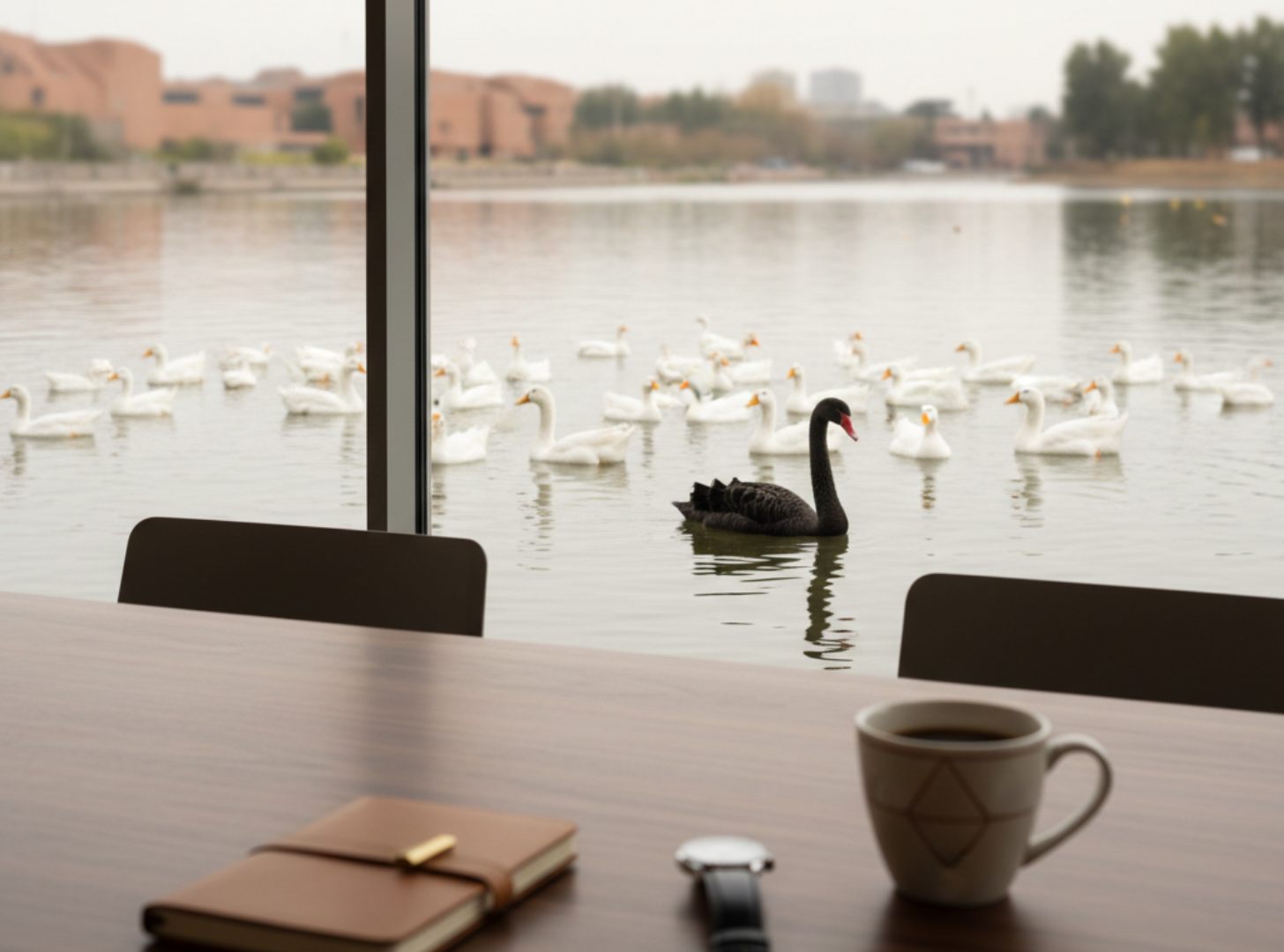
These are known as Black Swan events:
The black swan theory or theory of black swan events is a metaphor that describes an event that comes as a surprise, has a major effect, and is often inappropriately rationalized after the fact with the benefit of hindsight. The term arose from a Latin expression which was based on the presumption that black swans did not exist. The expression was used in the original manner until around 1697 when Dutch mariners saw black swans living in Australia. After this, the term was reinterpreted to mean an unforeseen and consequential event.
I know plenty of people who have been made redundant, including family members. It’s an event often out of the blue. Perhaps rumours had swirled, office gossip vine humming. But receiving the news that you are being let go is the official confirmation. You are now surplus to requirements.
A great many people in my friendship circle are separated or divorced. Many of them will say they didn’t see it coming, though after the fact they often talk about the red flags they missed. These are Black Swan events
Author Nassim Nicholas Taleb in his book ‘The Black Swan: The Impact of the Highly Improbable‘ popularised the idea of the “Black Swan”. He describes these events as outliers with a significant impact. They are unpredictable. Yet once they have passed, we have a peculiar human habit: we construct a story that makes the event seem inevitable.
This is what Taleb calls the “narrative fallacy”. Our brains are wired to find patterns in the chaos. We look back at a sudden job loss, a global pandemic, or the unexpected end of a long relationship and point to the signs we think we missed. We convince ourselves that we should have seen it coming.
But really, no amount of navel-gazing and red-flag pondering likely would have predicted the event. There is a danger in trying to rationalise the unpredictable; it gives us a false sense of control. The whole point of a Black Swan event is that it’s not predictable, and we must be careful not to presume that because we believed we could have foretold the last one, we can anticipate the next. That just leads to a state of hyper vigilance, draining our energy as we constantly scan the horizon ahead. It detracts from the here and now and pulls us away from being a good human in the now.
In his book ‘Antifragile: Things That Gain from Disorder‘, Taleb suggests that what we need is to develop ‘antifragility’, finding a way to grow because of the shock of an event.
Being resilient is about surviving the shock. Being antifragile is about finding a way to grow because of it. It is about building a life where our value isn’t tied to everything staying exactly as it is.
When a Black Swan moment arrives in your life, the temptation is to immediately ask, “How did I let this happen?” This question is often a form of self-punishment disguised as logic. It assumes you had a degree of control that you simply didn’t possess.
Instead of looking backward to fix the past, we might look at how we stand in the present. If the world is inherently unpredictable, the most practical thing we can do is focus on our character. We can focus on how we treat the people next to us while the ground is shaking.
We cannot predict the outlier, but we can decide what kind of person we intend to be when it lands.