The word “loneliness” has been around since the 1500s, but for most of that time it meant something closer to remoteness: a physical condition, not an emotional one. It wasn’t until around 1800 that it began to carry the weight we now recognise: the ache of disconnection, the sense of being without. That shift arrived trailing the industrial revolution like smog. Before it, we had “oneliness” - simply the state of being alone, with no judgment attached.
The distinction is subtle but vital. Oneliness originally described a state of being one, a singularity. It was an existential fact, not a clinical deficit. As we moved from factories to suburbs, we began to treat this natural state of being as a pathology. We turned a shared human condition into a personal deficit.
Today, much of modern culture blames individuals for loneliness. We can read endless studies that speak to an epidemic of loneliness in the world, spanning all age groups. We are told we must work harder at our social skills - go join a gardening club or take up a sport, find a new ‘tribe’. But this rather conveniently ignores the world we live in today.
Today’s world profits from isolation. It’s more expensive to live alone, to buy food, and fund our Netflix subscriptions.
In director Akira Kurosawa’s film Ran, an adaptation of King Lear, the fool Kyoami cries out: “In a mad world, only the mad are sane!“
In a world designed to keep us apart, feeling lonely is perhaps the most sane response available to us.
The philosopher and monk Thich Nhat Hanh in his book ‘The Heart of Understanding‘ spoke often of “interbeing”.
“If you are a poet, you will see clearly that there is a cloud floating in this sheet of paper. Without a cloud, there will be no rain; without rain, the trees cannot grow; and without trees, we cannot make paper... And if we continue to look, we can see the logger who cut the tree and brought it to the mill to be transformed into paper... The logger’s father and mother are in it too.”
His premise was simple: nothing can exist by itself.
We are always alone inside our own experience. That part is just true. But we are also, always, held in place by things we didn’t make and can’t see - human history, the work of everyone in our world, the environment.
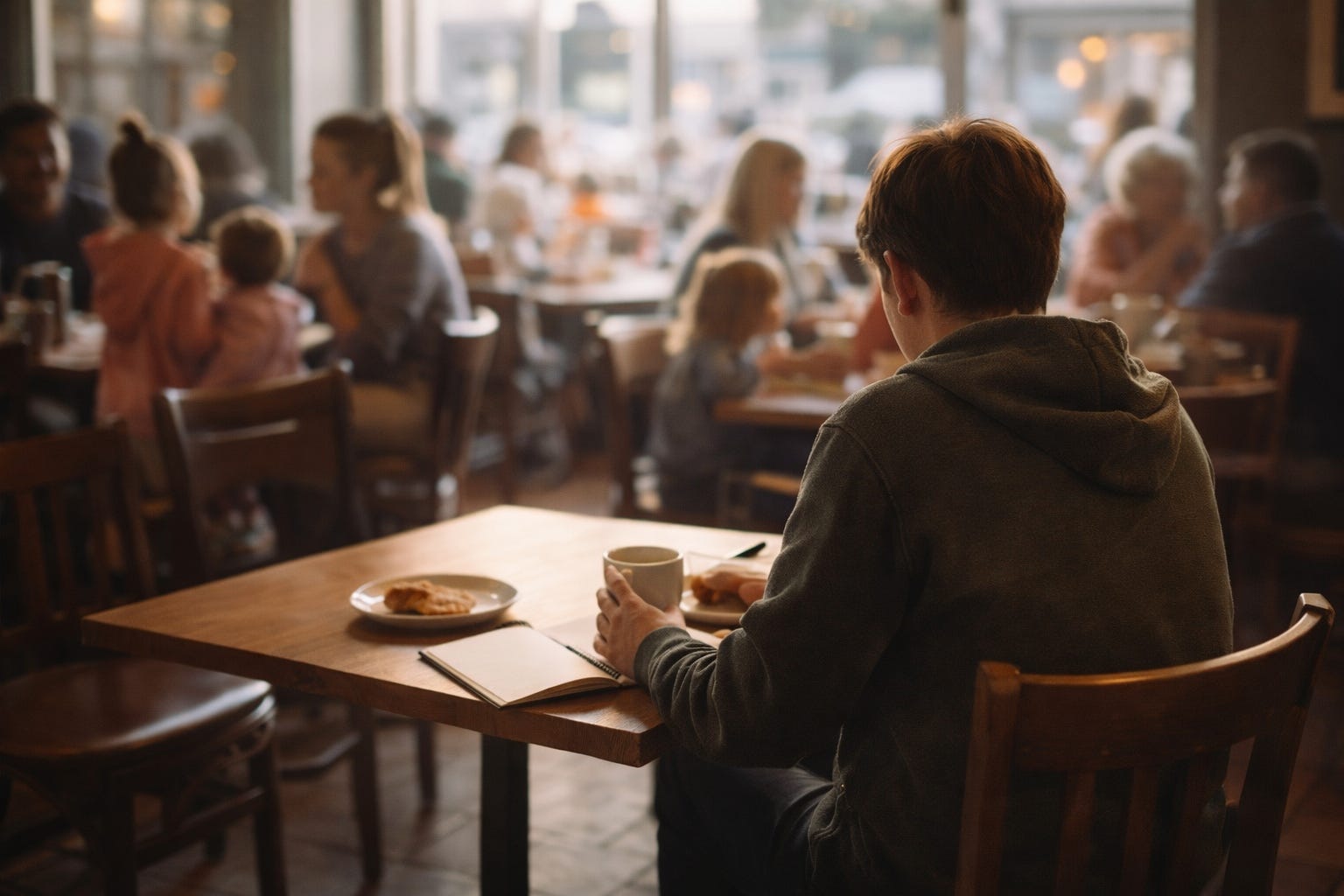
Oneliness offers something that loneliness does not: a context. It’s saying you are alone, but only in the way that every individual is alone. I’m writing this in my local cafe. It’s school holidays, and the place is buzzing with tables of parents, grandparents, and small children. I might be sitting alone, but I am not alone.
When we shift our lens from loneliness to oneliness, we start to look at the structures around us. We stop looking for a ‘cure’ for what is a part of the human experience.
Practising being a good human means leaning into this paradox. It means accepting our individuality while acknowledging our interdependence on the world around us.
We need to reframe the meaning - we don’t need to be ‘fixed’ - although please feel free to take up indoor soccer or join your local knitting guild. We must always remember that whilst each of us might be distinct, we are never truly separated from the world.
I’ve written before about the difference between loneliness and solitude.
There’s wisdom in recognising that solitude and loneliness are different creatures entirely. Solitude can be restorative, chosen, and peaceful. Loneliness is an unwanted isolation that can have a detrimental impact on our health.
How would your day change if you viewed your solitude not as a gap to be filled, but as a grounded base from which you relate to the rest of the world?
The goal isn’t to never feel lonely. The goal is to realise that even in our loneliest moments, we are still part of the whole.
While you are here, please check out Monika Jiang’s great Oneliness Substack and Podcast.