


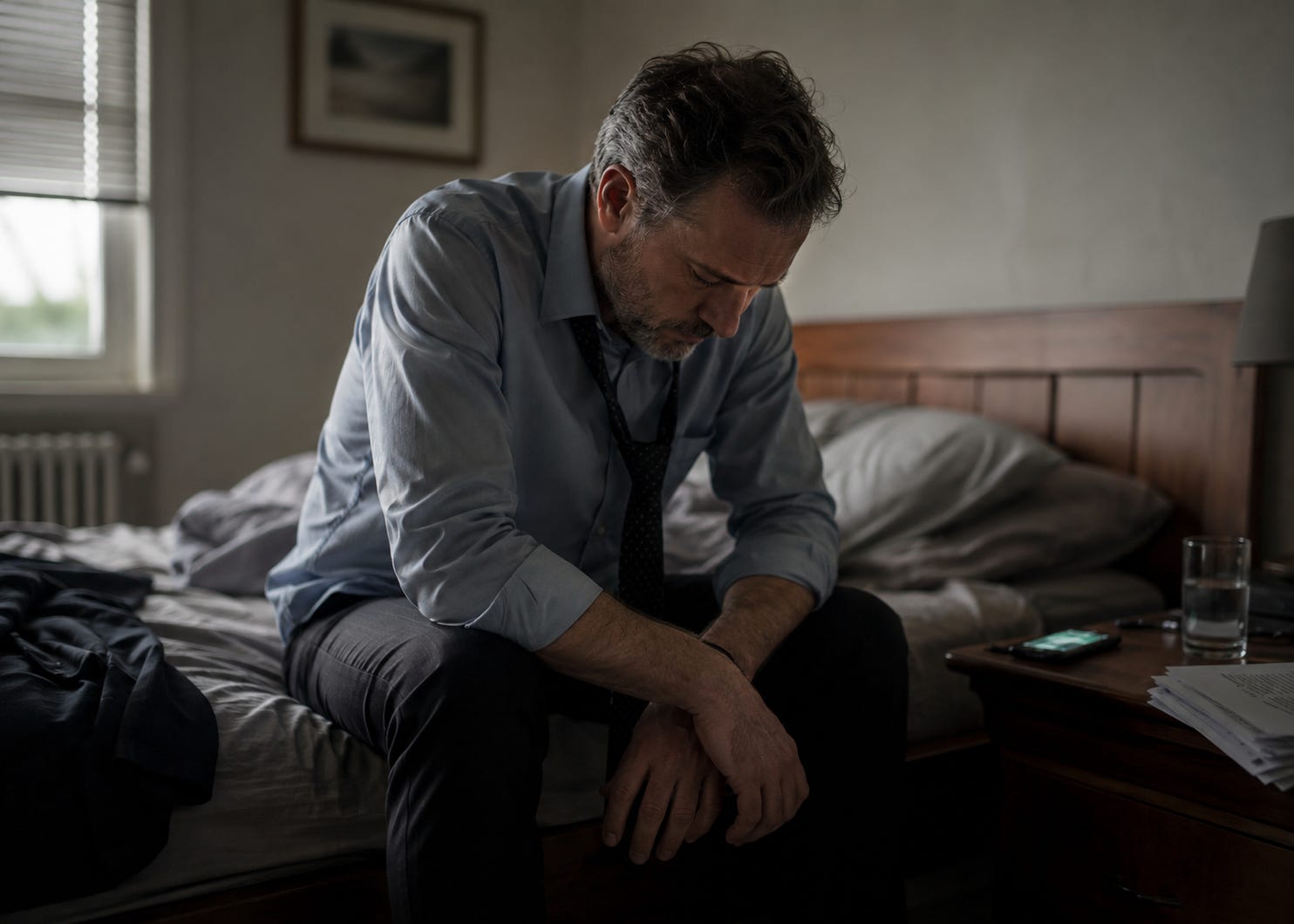
For most of my working life, I did not stop. My first business rolled into the next, then into consulting, then into whatever came after, and for years, I never really paused between them. At one stage, our youngest child faced serious health problems, and there were two other kids to raise on top of that.
It never once occurred to me to think strategically about my own well-being the way I would about any of my companies. Eventually, in May 2025, I stepped back from full-time work at the business I had co-founded, and only afterwards did I understand how close to empty I had been running.
I say that because there is a comfortable story about exhaustion, and it happens to be the wrong one. We treat burnout as a character flaw, evidence that a man could not handle what everyone else apparently manages, when the truth often runs the other way. The wall tends to get hit by pouring yourself into things that all matter, work, children, health and the people who lean on you, until there is nothing left in the tank.
Byung-Chul Han, the philosopher who described ours as an achievement society, one where we no longer need a boss to drive us because we have learned to drive ourselves, puts the point squarely.
“Burnout, which often precedes depression, does not point to a sovereign individual who has come to lack the power to be the ‘master of himself.’ Rather, burnout represents the pathological consequence of voluntary self-exploitation.”
The collapse is not a shortage of strength. Too often we have spent our strength on things we were right to care about at the time. But too many of us fail to recognise the cost, we’ve absorbed a culturally embedded truism that self-reliance is a prime quality for a man. We are engrained not to ask for help, that seeking assistance is an acknowledgment of weakness - I’m a man and a man carries his own load.
I have written before about the cost of being the dependable one, and it’s the same reflex that manifests in those approaching burnout.
The physician Gabor Maté, who spent years tracing illness back to hidden stress, names it plainly.
“The core belief in having to be strong enough... is a defence... One way not to feel rejected is never to ask for help, never to admit ‘weakness.’”
The habit that once helped a boy feel safe becomes the reason a grown man ignores every warning sign his body sends him. So the tiredness gets filed as a problem to push past rather than a message to heed, which is the opposite of what Maté recommends.
“Learn to read symptoms not only as problems to be overcome but as messages to be heeded.”
The tiredness is the message. The flat mood, the short fuse, the waking at 4 am, all of it is the body telling you the current arrangement cannot hold. What we must learn to do is treat these signs as needing attention, not as a symbol of weakness.
None of this means the answer is to care less, because much of what wears us down is worth the weight. It means noticing the signal early, before your body has to make the decision for you, and being willing to say out loud that you cannot carry it all this week. Stepping back, when I finally did it, was the right decision. Nothing is worth more than your physical and mental health.
“One way not to feel rejected is never to ask for help.” Goodness… I’ve never thought of it as fear of rejection, but I can see how this is true. Somewhere, the child we were was rejected by the person or people that they believed they could count on. That they trusted. And so we learned that all we can 100% count on is ourselves. We turned independence into a false virtue. That’s hard to walk back as an adult. Maybe the best we can hope for is to raise our kids differently.