


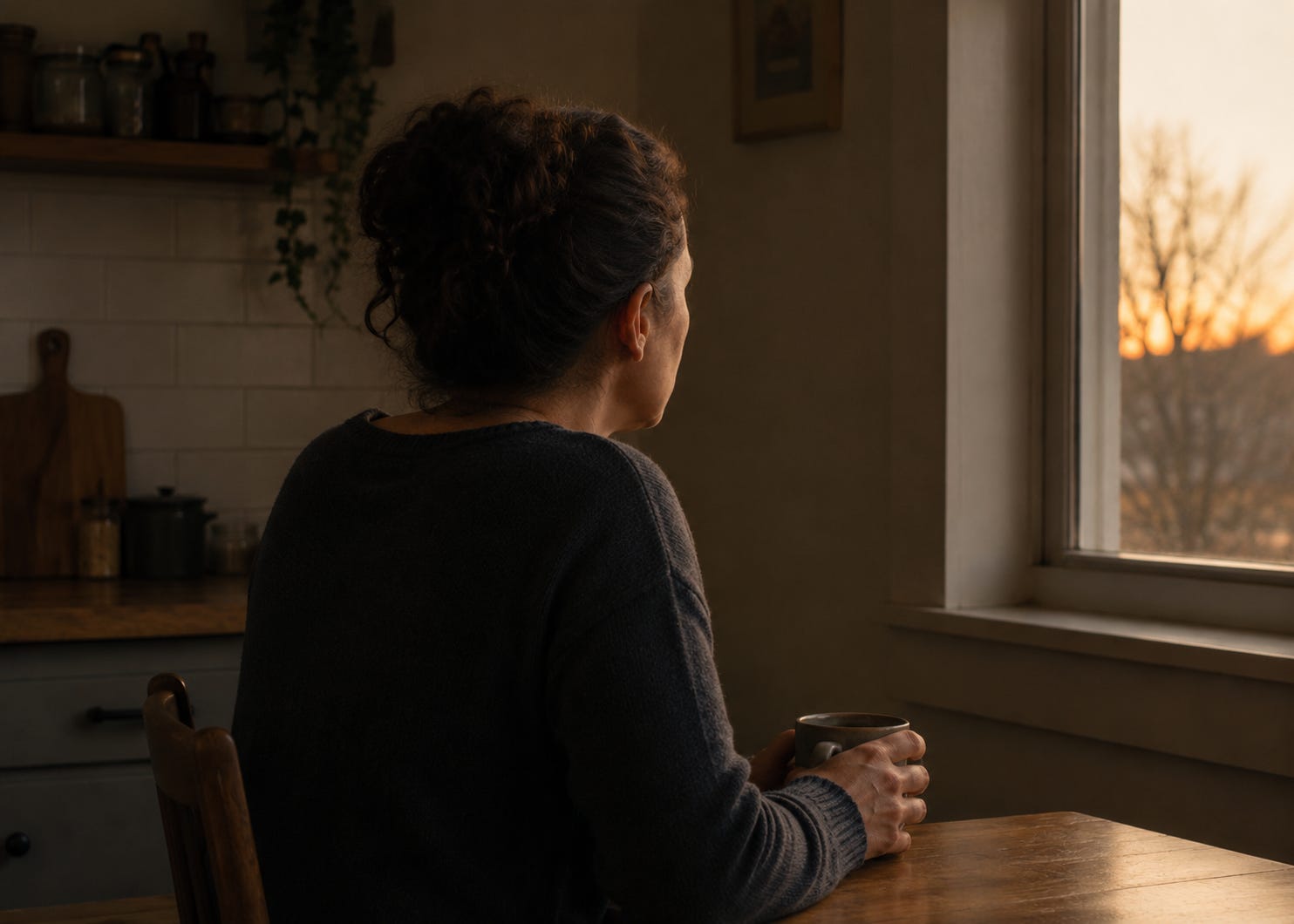
I’m rubbish at doing nothing. I can close my laptop, but then I pick up my phone. I can put the phone down, then notice a cobweb. On the way to grabbing a broom to tackle the cobweb, I remember there’s washing that needs to be moved from the machine to the tumble. That is when I notice the cardboard in the garage that needs to be cut up and put in the recycle bin. If you ask me to sit down for ten minutes with no distractions, I really struggle. I can sit staring on the couch, staring into space, and almost immediately I’ll think of something that needs to be added to the shopping list.
I find it hard to let my mind settle. I know there’s all sorts of advice for this, for example, sit longer, breathe slower, notice my thoughts but let them pass, but there always seems to be something that drags me back to the present. What the generally accepted advice tends to skip is the part where, if you are lonely, your brain has a good reason to refuse.
Loneliness is not simply an unpleasant mood layered over an otherwise normal brain. Researchers who study it describe something closer to hypervigilance, the same heightened scanning for danger you would expect in someone bracing for a threat. Stephanie Cacioppo, who has spent years researching the neuroscience of connection at the University of Chicago, in an interview about the mechanism, said:
“Feeling socially isolated from significant others is not only sad, it feels dangerous.”
Her husband, John Cacioppo, has spent decades researching how the brains of lonely people respond to social threat cues faster than those of people who are not lonely. The idea is that for centuries, people who found themselves on the edge of the group of people around them could be a death sentence - you are more likely prey for predators both animal and human. So your nervous system sees isolation, being on the outer, as an emergency rather than just something seen as inconvenient. Staying still, away from your group, is not a great move if you don’t want to be eaten.
Today we speak a great deal about mindfulness, and how we should stop monitoring the world around us for a time, to just sit in the present. Except thousands of years of conditioning must be overcome for a lonely mind to seek presence. So our minds jump around, either looking for tasks - like my washing - or pondering past, present or future, anything to distract from the empty room and trigger alarm bells.
The proponents of ‘being present’, being mindful, can often portray it as a switch you can flick on or off at will, but that’s not how your nervous system works when it feels under threat. You can’t reset your mental smoke alarm when it’s already binging loudly to tell it the house is not on fire.
But please don’t see this as a personal failing; you are not alone. John Cacioppo, in the book that became his life’s work, wrote:
“People who get stuck in loneliness have not done anything wrong. None of us is immune to feelings of isolation, any more than we are immune to feelings of hunger or physical pain.”
Clearly, I am not great at sitting around when my mental smoke alarm is sounding; it’s a built-in reflex response. I touched on this same mechanism last year, in The Quiet Epidemic: How Loneliness Became a Public Health Crisis:
“Loneliness triggers our ancient survival mechanisms. When our brains perceive social isolation, they interpret it as a threat, because for most of human history, being cut off from the tribe meant death. Our bodies respond accordingly, flooding us with stress hormones and putting us into a state of hypervigilance that, when chronic, wreaks havoc on our physical health.”
So how can you sit in an empty room and ignore the alarm? The shifts are small; instead of forcing complete stillness, try giving your nervous system safe and familiar sights and sounds. Perhaps, like me, sit in your cafe and allow the chatter and noise to wash over you. Or go for a walk with the sounds of traffic or wildlife surrounding you. You need to give your body permission to enjoy the mental quietness, whilst buoyed by the familiar.
The shift does get easier, but it’s much more about practice and repetition than any kind of iron will. You must teach your brain to recalibrate, so it learns to constantly stop seeking danger or distraction. Those restless moments have to be expected, but over time you can dial down the reflexive response, convince it the danger has passed, even if it takes longer than a few deep breaths.
DO YOURSELF A FAVOUR
That was Molly Meldrum’s line, and it still holds up. You’re reading Alone Rangers for free, that’s not changing. But a paid subscription keeps it free for everyone else and puts a few dollars behind work that’s trying to say something true about loneliness and connection.