


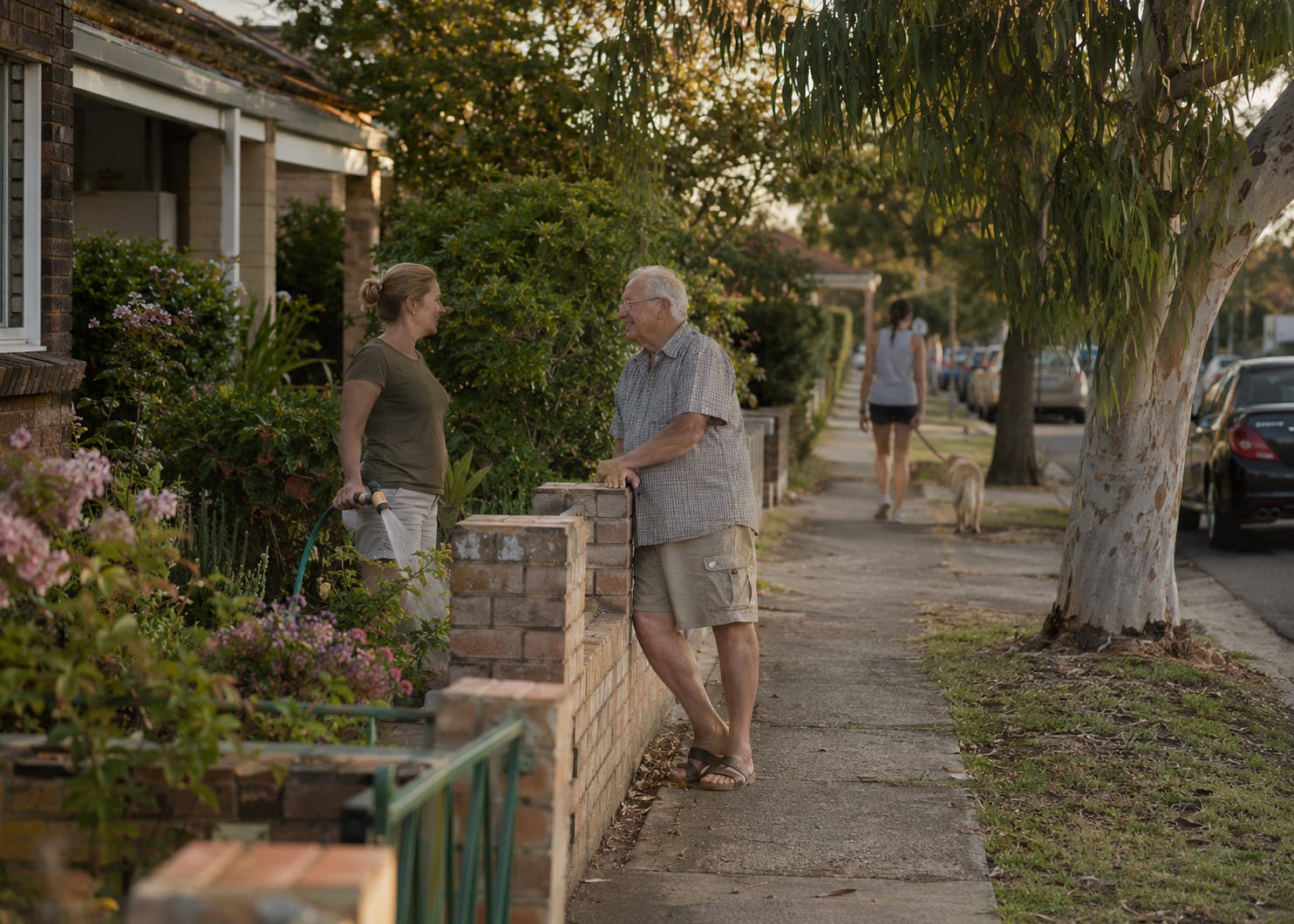
Ask Australians whether the country is holding together, and most will tell you it isn’t. In this year’s Mapping Social Cohesion report from the Scanlon Foundation Research Institute, 62% of adults said Australia is less cohesive than it was three or four years ago, and 48% said they feel pessimistic about the country’s future, up from 43% last year and the highest figure since the question was first asked in 2017. Ask the same people about the street they live on and the answer flips. Around four in five say they belong in their neighbourhood and that the people around them are willing to help each other.
Reading last year’s report alongside this one, that gap is what I keep coming back to. The headline Scanlon Index of social cohesion has sat at 78 out of 100 since 2023, which sounds dull until you think about what those three years have held, with rate rises, rents and grocery bills climbing, and a bitter public argument about immigration that hasn’t let up. Plenty of the national numbers did move, and mostly in the wrong direction. I’m Gen X, at the older end of it, and the share of my generation expecting life to be worse in three or four years has risen from 22% in 2014 to 36% now. Unhappiness has crept up for Gen X and millennials alike.
The neighbourhood numbers barely shifted between the two reports. In 2025, 82% agreed that people in their local area are willing to help their neighbours, and in 2026 it was 81%. The researchers, led by Dr James O’Donnell at the Australian National University, put it this way:
“Such emotional and practical community bonds are not so easily shifted in response to national and global events and trends.”
That matters more than it might seem, because the report also tracks what those bonds do for people when money gets tight. In both years, financial strain sits among the things most closely tied to unhappiness and weaker belonging, and yet the researchers found a buffer:
“people were much more likely to be happy in the face of financial pressures if they lived in close-knit communities.”
I’ve been writing about loneliness here since 2021, and a lot of it has been about how men lose connection when the scaffolding of work, sport and family routines falls away. What these reports suggest to me is that the local, low-stakes contact we tend to dismiss, the wave over the fence or the chat at the bakery queue, is doing more of the heavy lifting than the national conversation gives it credit for. I wrote recently about how much easier it is to talk to a stranger when you’ve got a small reason to, and the Scanlon data reads to me like the population-wide version of that idea.
The report does carry a warning. The streets may be holding, but the groups that used to bring people out onto them have been shrinking for years. The researchers estimate that 68% of adults were actively involved in a social, religious or community support group in 2010. In 2026, it’s 48%. People who live alone report feeling isolated at higher rates (55%, against 47% across all adults), and they are often the ones who rely most on that local contact.
So I’d read this report as a reason to be less frightened by the national mood and a bit more deliberate about the local one. Most of us still feel the belonging we have where we live has been built up through years of small, ordinary contact, and it’s easy to assume it will look after itself. The participation figures say it won’t. Joining one thing near home, or turning up to the next street or club event you’d normally let slide, is a small way to help keep your own neighbourhood among the four in five.