


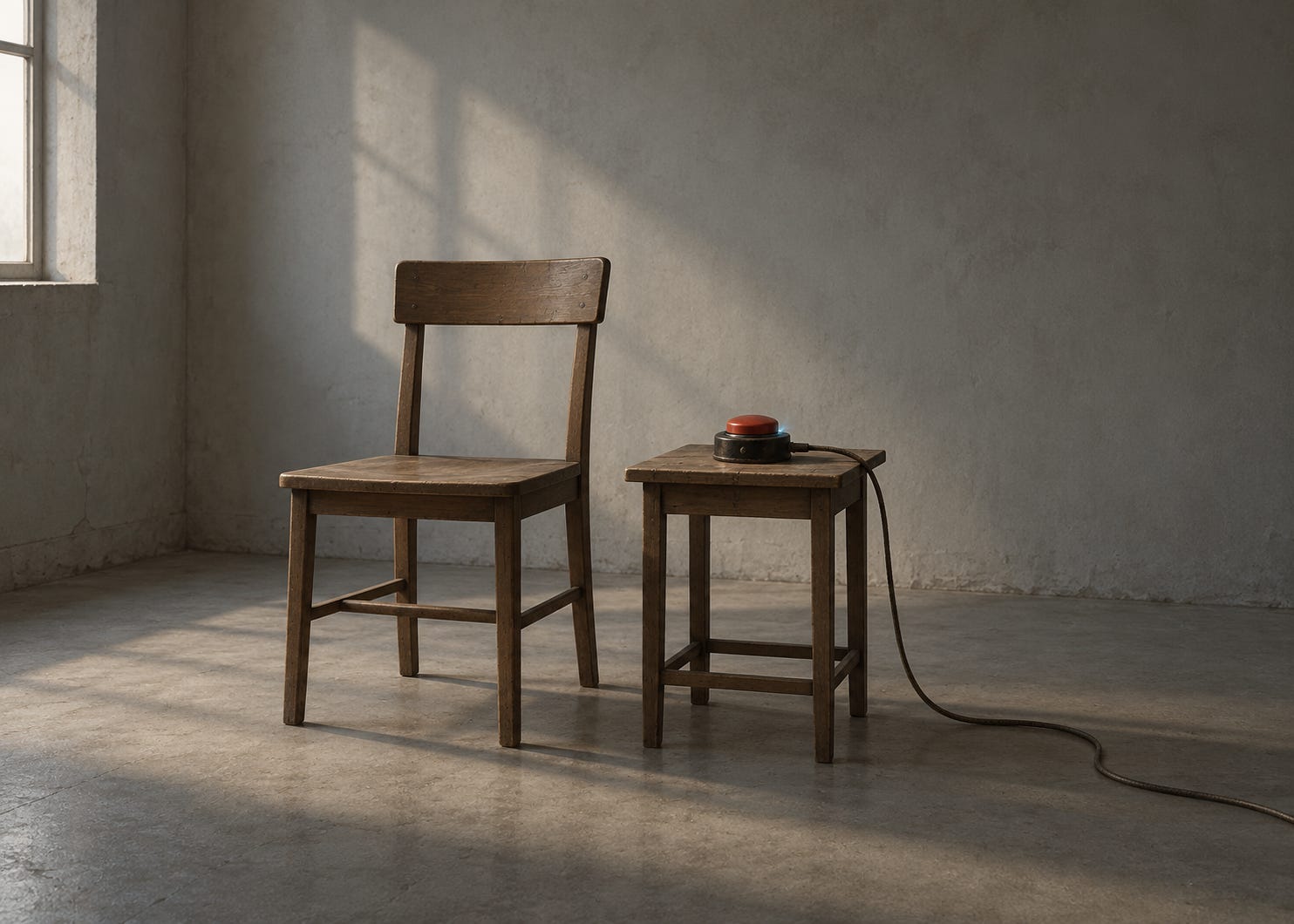
A group of volunteers at the University of Virginia were asked to hand over their phones and led into a room bare except for a chair and a button as part of a study led by psychologist Timothy Wilson. They were simply told to sit quietly for 15 minutes alone with their own thoughts. In preparation, a little earlier they’d been given a mild electric shock and asked whether they’d pay to avoid another one.
The button next to the chair would deliver the same mild shock; it was purely voluntary if they chose to push it.
In the study, published in 2014, 18 of those 42 people pressed it at least once. One man pressed it so many times - 190 in 15 minutes - that they left his data out of the study. More men than women pushed the button.
Chris Chambers, a psychologist at Cardiff University, told the BBC:
“This is essentially a study showing that people don’t like to be bored.”
A Tilburg University team repeated the experiment in 2022 and got much the same result, though they suspected plenty of people pressed the button
“because they were curious about the shocks, their intensities, and the effects they would have on them.”
What interests me more is that when Wilson’s team let people read, listen to music or browse the web instead, they enjoyed the time much more. When older volunteers tried the same experiment at home, they fared no better than the previous group.
Ivo Vlaev, of Warwick University and Imperial College London, read the results this way:
“The bottom line is that they felt miserable. Research has shown that happiness is not only about experiencing pleasure. You need a sense of meaning and purpose, which you lack in these conditions. And when you have a task to do, you do have that sense, even if it’s a simple task.”
Boredom and loneliness are different things. You can be bored at a party filled with people, music and chatter, and be perfectly content on your own. It’s the small tasks that give shape to the day - unpacking the dishwasher, putting out the bins, saying hi to our neighbour, or working on a document for your job. They give us purpose and make us feel part of something - that we matter.
Psychologists literally call this mattering, the sense that other people notice you and rely on you. Gordon Flett, a psychologist at York University in Toronto who has spent years studying it, put it to AARP:
“I am convinced that a big chunk of the loneliness epidemic is a ‘not mattering’ epidemic.”
When we go through a major change in our lives, perhaps retirement, or redundancy, or divorce, we lose a bundle of the things that matter. I’ve been experiencing this first-hand. My son moved out last year, my eldest daughter has lived interstate for several years, and my youngest is only with me half the month. Plus, I don’t work full time anymore, so I’m rattling around my house by myself during the day. If I don’t eat lunch, or don’t get around to put a load of washing on, actually it doesn’t really matter unless I notice I’m hungry or out of clean jocks.
If you're in the middle of this yourself, you're not the only one. Plenty of us have watched the small jobs that gave our days shape quietly disappear, and felt worse for it than we expected. I write about loneliness, purpose and the ordinary ways we stay connected most weeks. Subscribe to get the next one.
I’m ok with solitude for a time; I don’t feel pressured or under the pump to get things done. But these times when I am alone make me realise I do actually quite like feeling needed - yet there’s often nobody around who needs me.
When I moved into semi-retirement, it shifted how I thought about purpose, and I wrote about that in Living with Purpose: A Guide for the Beautifully Lost. My point then was that for most people, purpose is a blend of small things done consistently. I still think that’s right, and the Virginia study, odd as it is, supports it. Psychologists use the same idea deliberately in behavioural activation, a well-tested treatment for low mood that starts with small, achievable activities rather than waiting until you feel like doing them.
So hang on to a few small daily jobs that are yours, even when someone kindly offers to take them off your hands, whether that’s watering the plants or walking the dog around the same block. And if your own list has thinned out, look for one small way to be useful to someone else this week, like collecting a neighbour’s parcel or ringing the mate who’s just retired to ask for a hand with something. None of it needs to be grand - small things are just as important. Those people in the room with the button would likely have been perfectly happy with a book or some music. Or a basket of washing to fold.
DO YOURSELF A FAVOUR
That was Molly Meldrum’s line, and it still holds up. You’re reading Alone Rangers for free, that’s not changing. But a paid subscription keeps it free for everyone else and puts a few dollars behind work that’s trying to say something true about loneliness and connection.