


I’ve sat in many meetings, both personal and professional, where one or more people are owning a mistake or misstep – sometimes it’s me. One person who championed an idea or plan explains that it didn’t work out and maybe reflects a little on why. They speak calmly and logically, and everyone acknowledges it; it prompts a discussion about how to avoid the issue next time, and after a while the group moves on.
In contrast, another person explains a similar misstep, but their body language is closed and awkward. Their voice drops, their shoulders hunch, they avoid eye contact, and others around the table start to manage the confessor’s feelings; the discussion stays on the error. Both people made an error, but it’s the second person who makes it about the error.
I’ve spent twenty-five years running companies, which mostly means I’ve spent twenty-five years watching people decide, in the space of a single sentence, what a mistake says about them. I’ve written before about accountability:
“We cannot control everything around us, however hard we try. We cannot control everything that happens to us. There’s no point blaming our upbringing, circumstances, or other people’s behaviour for our problems. But we can control how we respond. If problems are ours to own, then they are also ours to solve.”
Some people can say “It’s my fault” and move on. Others hear themselves say it and immediately start building a case for why they’re still a good person; they seek to reinforce their character to counter a perception of shame. Brené Brown’s research on shame names this reaction:
“Shame is a focus on self, guilt is a focus on behavior. Shame is ‘I am bad.’ Guilt is ‘I did something bad.’”
In this framing, guilt is useful. It points at a specific action, and a specific action can be fixed, apologised for, or avoided next time. Shame is an emotion that embraces the whole person, and leads to a desire to defend the feeling. A more emotionally secure person can label the emotion; they still feel the discomfort, maybe the guilt, but they can take the step back from the emotion without encouraging others, and themselves for that matter, to make it the basis of a verdict on their character.
It’s perfectly natural that our instinct to protect ourselves from negativity comes to the fore, but when we try to hand off the blame – to pass the buck - it’s a futile attempt to cover up. Brown’s other observation, from Daring Greatly, is that
“Blame is simply the discharging of pain and discomfort. It gives us some semblance of control.”
Shame and blame are the opposing strategies; shame is internalised, and when we do, we likely call it self-awareness. Blame, on the other hand, moves outward and probably gets labelled as honesty. But neither is useful because it distracts us from what we should be doing: looking clearly at what happened and considering how we might change next time.
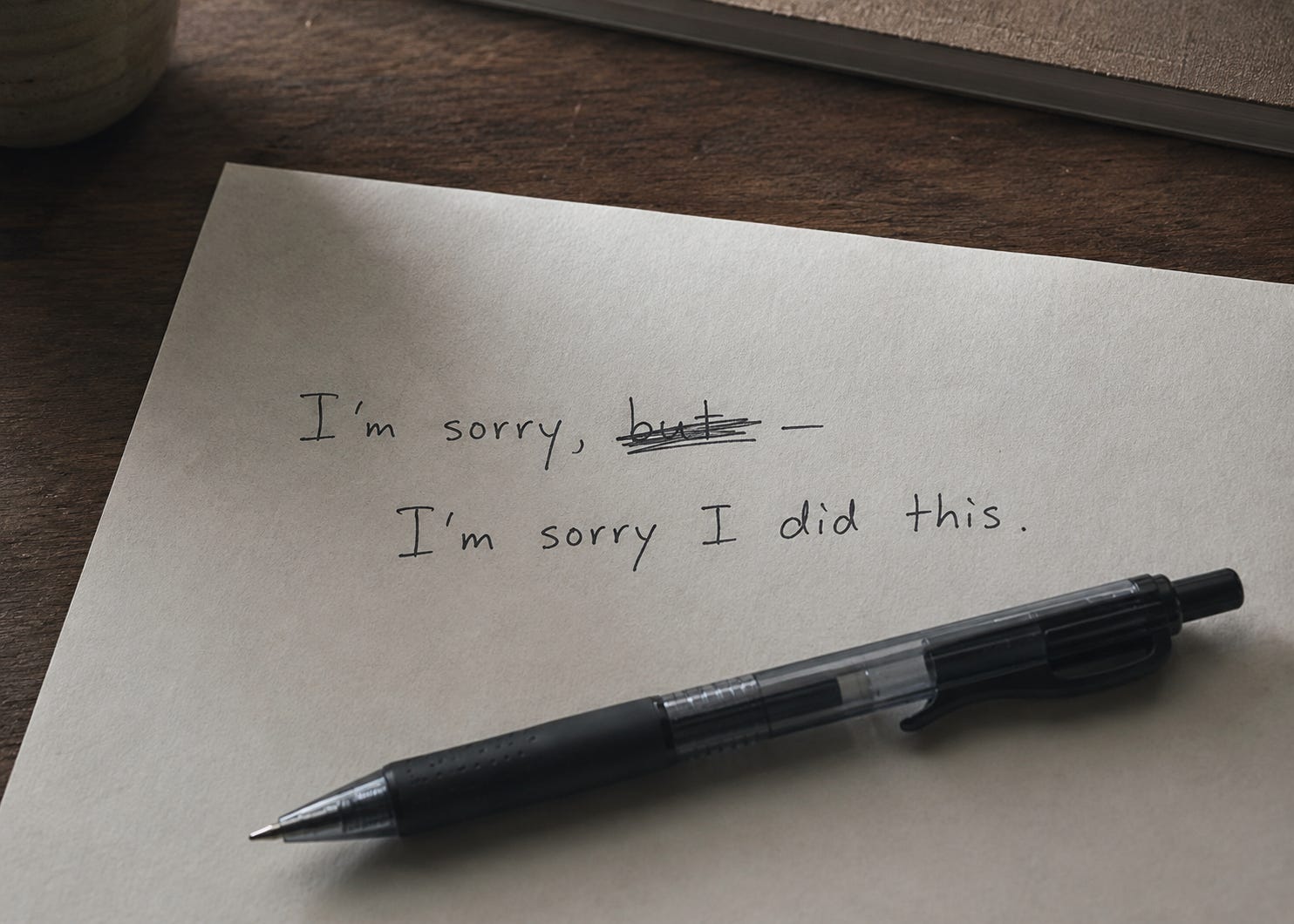
Have you heard someone say “I’m sorry, but you have to understand”? That’s them passing on the discomfort. Or, “I’m sorry you felt hurt”, which I don’t think comprises a real apology. What is really needed is to state the problem and why it was wrong, name the remedial action, and stop talking! Less performance, more accountability.
We must be careful not to fake accountability; visible anguish (“Oh dear me what have I done?”) and self-flagellation (“Oh woe is me!”) can give the impression of accountability. The performance is all about how much this is costing me, so a quest for reassurance, rather than an actual fix. Real accountability is not a performance nor an apology tour.
We mustn’t, though, diminish a mistake; if we are not uncomfortable after getting something wrong, then we are not demonstrating maturity, but when discomfort is pointing to what we did, it’s doing the right job, and not seeking to pass a verdict.
I’m pretty sure I haven’t nailed this all the time, but what I’ve learned is that you can tell pretty quickly which way someone is leading the conversation - are they going to fix the problem, or are they needing you to tell them they are still a good person? The first means you can both move on; the latter floats discomfort into the room looking for shoulders to carry it.