


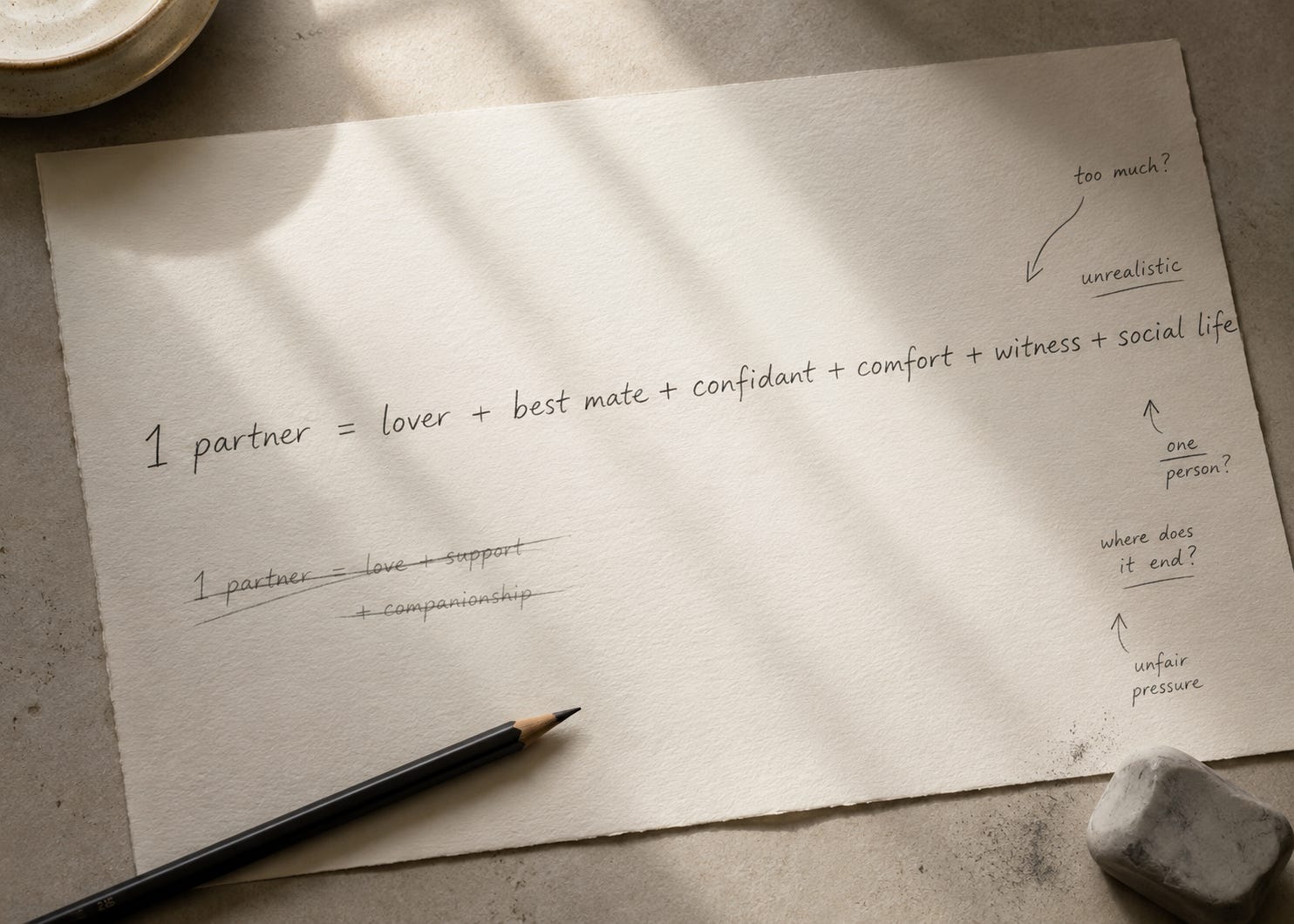
A lot of people are lonely inside relationships that are otherwise perfectly fine, and they don’t say so because admitting you need more than one person to carry the load can sound like an accusation against the partner who’s supposed to be enough. It isn’t one. Nobody was ever built to hold everything on their own, partner included.
Most of us inherited that equation without ever choosing it. Find the right person, and somehow one relationship is supposed to be your lover, your best mate, your confidant and your whole social life rolled into one. It rides on what the writer Amy Gahran calls the relationship escalator, the assumed sequence of dating, exclusivity, moving in and marriage that most people climb without ever treating it as a decision. I wrote about getting off that escalator before, in a piece on Living Apart Together. None of it gets said aloud, but the partner at the top is supposed to be enough on their own.
It’s the ending of every romantic film and the chorus of half the songs on the radio, so when the gap turns up anyway, it rarely gets read as ordinary maths. Most people read it as a verdict on themselves or on the relationship.
A piece in Psychologies on the rise of open relationships put language to that exact gap, in a way I think most people would recognise, whether or not non-monogamy has ever interested them. The clinical sexologist Ilka Kemp-Hall told the magazine:
“More people than ever before are beginning to question the idea that one person should meet every need and are placing more emphasis on communication, consent and emotional honesty. There’s a growing openness to exploring different relationship models, rather than defaulting to one ‘right’ way of doing things.”
Strip away the headline, and the real idea in that quote has nothing to do with who sleeps with whom; it’s an admission that no single person can carry someone’s entire emotional life alone, however well chosen they are. Ethical non-monogamy just makes that admission explicit, building agreements and check-ins around it instead of leaving it unspoken.
None of that is unique to men, the gap itself is the same for anyone in a relationship, what’s different is mostly practice: men get less room to name a need before it curdles into distance or resentment, and fewer obvious places to put it once it shows up. Either way, the gap tends to get carried alone, which is where the loneliness from earlier really comes from, the feeling of needing something a partner cannot supply and having nowhere sanctioned to put that need, rather than anything to do with being single.
Most of us quietly expect a partner to absorb every need on their own, to be the one you vent to, your main source of comfort, and often the only person who still asks how you’re travelling. When that expectation doesn’t hold, because no one person was ever built to carry all of it, the shortfall rarely sends you looking for a mate, a hobby or your own family to fill the gap. It just gets carried alone and read as proof of the relationship, or you have failed, when it’s really just a flaw in the original equation.
The psychosexual therapist Lucy Frank, also speaking to Psychologies, made a point worth keeping even if you have zero interest in opening anything up:
“My clients are very dedicated to getting it ‘right’. Ultimately, they want it to enhance the dynamic, not erode it.”
You don’t need to renegotiate your relationship to use any of this. You just need to stop treating your partner’s limits as evidence that something’s wrong, and start treating your mates, your family and your own interests as legitimate places to put a need, instead of as a sign you’ve failed at the relationship. My article, The Friendship Pyramid Is a Map, Not a Mandate, covers similar ground: no one person was ever meant to carry an entire friendship network, and loneliness comes from the same source.
The relief in that Psychologies piece was never really about the bedroom. It was about giving up on an equation that quietly tells us a good partner should be enough on their own, the same equation built into the escalator most of us boarded without ever choosing to get on. You didn’t pick the wrong partner, and you didn’t get on the wrong escalator; you’re just human, and that gets a bit easier to carry once someone else takes a piece of it.