


Almost every close friend I have is divorced or separated and in their 50s. They date, they socialise, and some have adult kids drifting in and out. Outwardly, they often seem content, but this too often masks the precarious financial survival beneath the surface. Because, like me, they’re all paying more than they should be for the lives they’ve built.
It all comes down to money: rent or mortgage, utilities, insurance, rates, all of it lands at 100% rather than the 50% a shared household pays. The Aldi run costs one person nearly as much as it would feed two. Take a trip away, and a hotel room costs the same for one person as for two; the tax system prefers people who’ve coupled up. Individually, none of these is disastrous, but cumulatively, they add up to a levy that, by most other measures, is going fine.
“Grey divorce” is on the rise in Australia. ABS data show that in 1990, 13% of Australian divorces involved someone over 50; by 2020, it was 27%, and it now sits at close to a third. People living alone already make up 26% of all Australian households, and that share is projected to reach 35% by 2046. Yet the housing market, the tax system, and the pricing of just about everything conspire to penalise us single 50-somethings.
The rental market is where it really hurts. I’ve had several single friends who need to find a place to live and struggle terribly. Rents across Australian capital cities peaked at 8.5% annual growth in late 2023, and at the worst of it, 94% of new tenancies saw increases. I’ve driven past home opens for rental units with queues of dozens of people waiting to look around. Oh, and don’t tell the agent you have a dog; that instantly puts you at the bottom of the queue.
It feels unjust and unfair. You’ve carved out a life, moved on from a long-term relationship, and are starting to think about what the next stages of your life might look like, perhaps as work scales down, using the time freed up by the kids leaving home, but now you can’t afford a home.
I noted my new obsession with tiny homes in an article a few weeks ago, and the idea of them as a practical response to a problem nobody seems interested in solving. I’m fully over the big house dream; I’d like my life to be simpler, cleaner, less cluttered and tiny houses offer a model for living that delivers this.
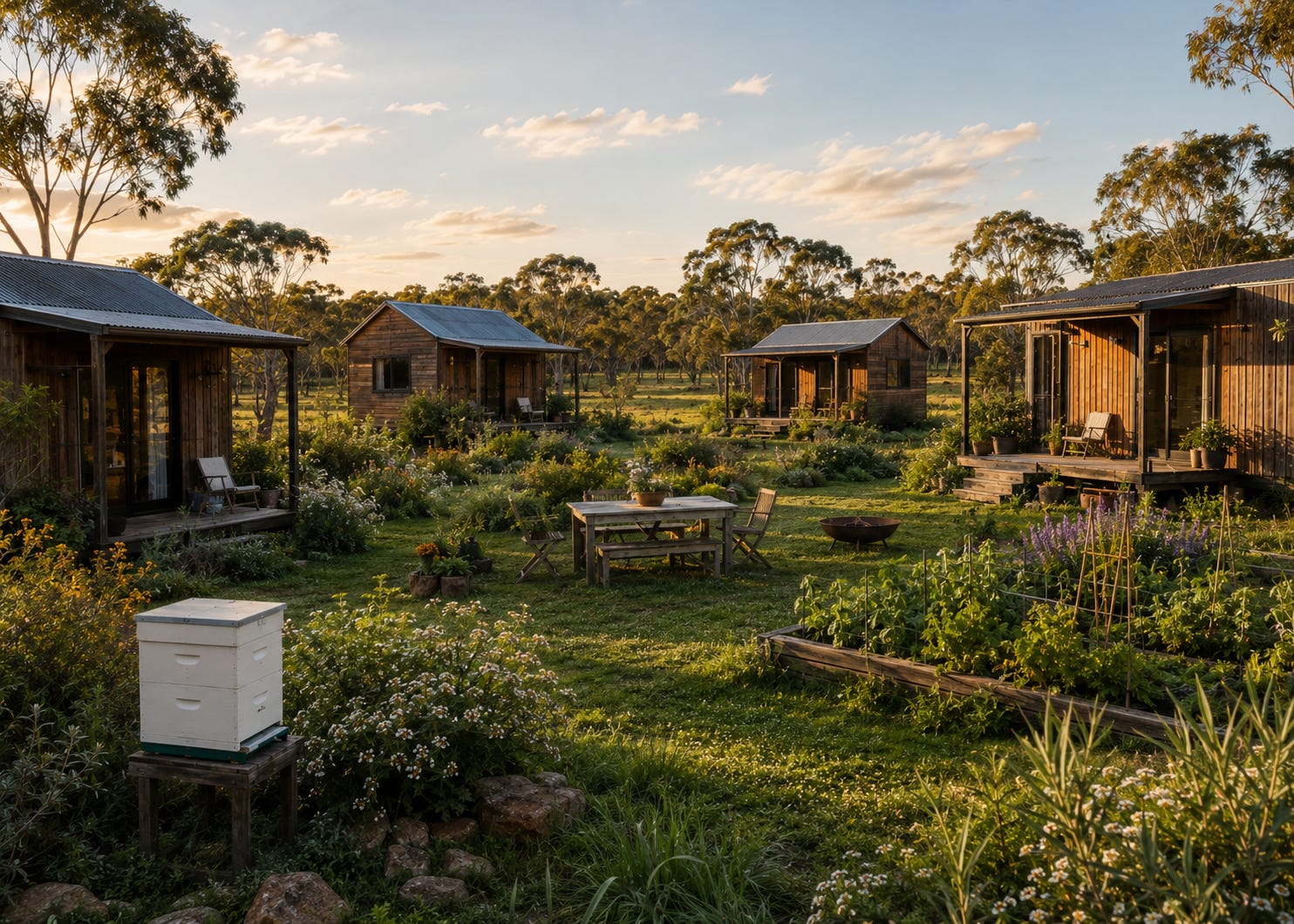
Combined that with looking around my friendship circle, and the idea that keeps bubbling away at the back of my mind is a bunch of us roughly in the same situation coming together to buy a block of land not too far from civilisation, and setting up a group of tiny homes. A community that doesn’t require anyone to give up having their own space, and at a price that is affordable.
There’s a formal name for something like this - cohousing - and versions of it have been running successfully in Scandinavia for decades, with a few projects starting to appear in Australia. Most skew toward families or retirees. There’s almost nothing designed for the people in the middle: past raising kids, not yet thinking about aged care, stretched thin by solo overheads, and wanting some company without having to negotiate whose turn it is to clean the loo.
It feels to me like this is the missing piece for us 50-somethings who have not repartnered, or who have decided that, irrespective of whether a new relationship eventuates, we’d prefer to live independently. It’s an option that sits between competing with 100 others for a one-bedroom rental flat and moving in with someone.
Like my friends, I am not looking for rescue. I like my life; it’s just that my friends and I are paying too much in a world that doesn’t provide an easy spot to slot into.