


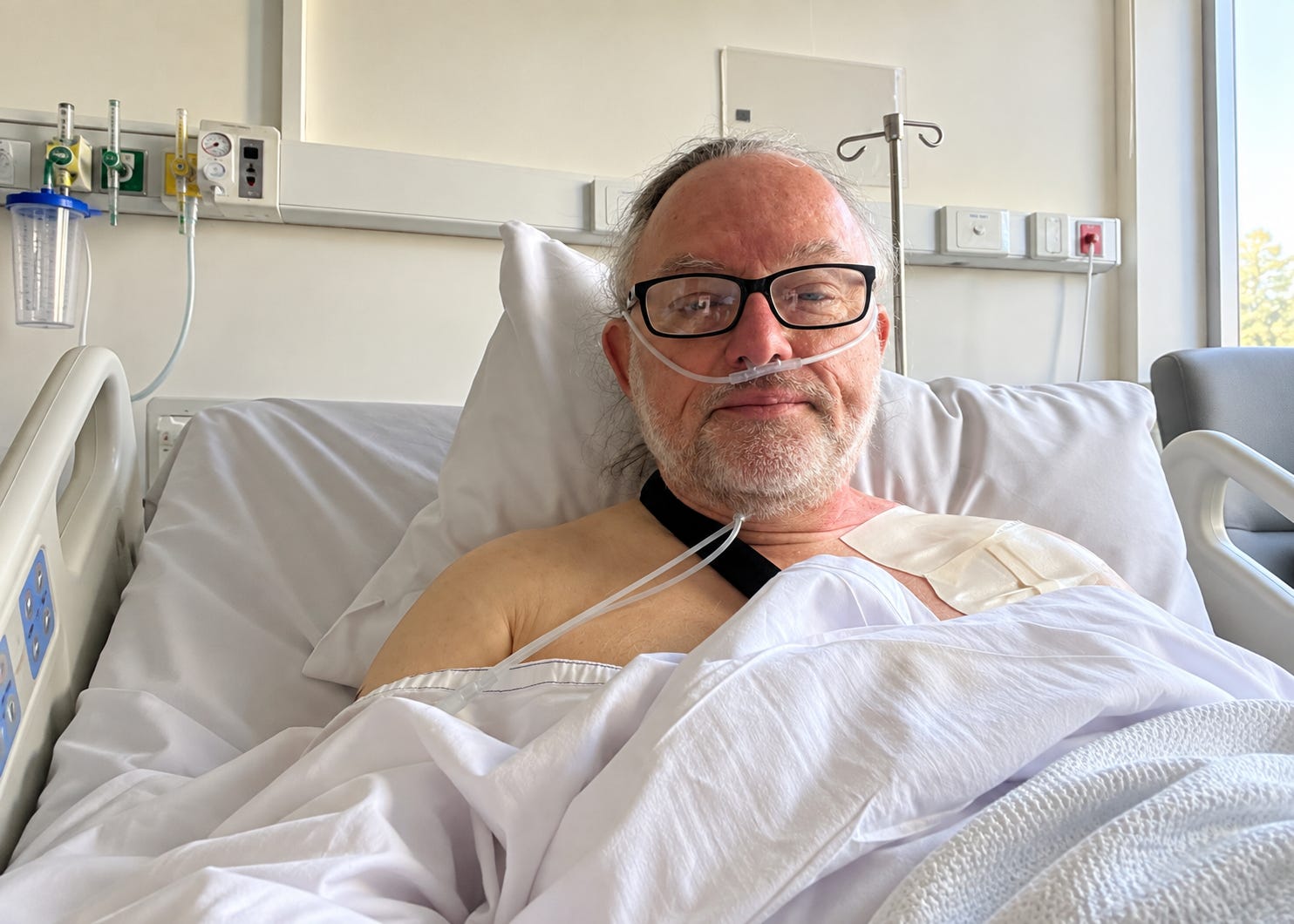
Two weeks ago I went into hospital for shoulder surgery. Quite a while ago now - maybe 12 or 13 years - I was showing off at 10-pin bowling with my children a bit more than I should have. Of course, I was getting strikes and enjoying showing off to the kids. But when I woke up the next morning, I couldn’t lift my right arm; I had torn the rotator cuff muscle in my right shoulder. I had a bunch of physiotherapy, and over time it seemed to heal.
Fast forward to the middle of last year, I became aware of progressively worsening pain in the same shoulder. I went for an MRI, which showed two different things: firstly, that the tear in my rotator cuff muscles really hadn’t healed properly all those years ago, and secondly, bone spurs had developed in the shoulder joint, which prompted a diagnosis of osteoarthritis.
For the last few months of 2025, my shoulder really gave me quite a lot of trouble. I went to see specialists, had more scans, and was told I would need surgery at some stage to correct the issue. For a while I stopped a bunch of my regular exercise, especially swimming, because it was painful - I couldn’t roll my right arm over without almost feeling like the bones were grinding at certain points as I lifted my arm.
However, come the new year, I made a firm decision to get back into it. I was also prompted by seeing some videos explaining how your arm is essentially a noodle that flops around, and so much of the strength and power comes from all of the muscles around the shoulder - that’s what allows you to lift your arm and wave it around. So I went back to swimming, doing breaststroke and other things that didn’t require me to roll the arm over.
I also had a long conversation with my Pilates studio, and we completely restructured my program so that I started doing two studio classes a week, really focused on building up my body strength, both core and around the shoulder and all the support muscles. Lastly, I decided to lose some weight. I was heavier than I’d ever been; a gradual increase over a couple of years had crept up on me. Over the last four months or so, I’ve taken 15 kilos off - which had the added benefit of really improving my capacity to execute a bunch of the harder Pilates moves.
Then finally I got a date for surgery. I absolutely felt like I was in a good place for the operation; I felt strong, and my body felt good apart from the ongoing pain in my shoulder. I showed up at my local hospital; they put me to sleep, did the work, and I woke up a few hours later feeling very sore and sorry for myself. They kept me in overnight and sent me home. My instructions are to wear a sling on that arm for six weeks, and probably not start any great strength rebuilding for three months.
Of course, I’m right-handed, and this is my right shoulder, so everyday living has some entertaining moments - things like cleaning your teeth with your left hand is an experience, as is doing up shoelaces and all the everyday activities we take for granted when both hands are working.
I’ve even discovered the joys of home delivery by DoorDash from my local ALDI, so easy enough to have groceries delivered without me needing to drive - driving is an obvious problem when one is in a sling, and you’re experiencing quite a lot of pain when that arm is rocking around.
What has really made the difference is how my friends have stepped up for me. They’ve even created a roster to make sure that at least for the first week or so, somebody is with me regularly, staying over at night, making sure that everything’s okay, keeping me company because otherwise I’d be at home by myself.
If you’ve been following my writing for a while, you will know that asking for help has been a blind spot for me. I’ve been so used to being a one-man band, really independent, making sure I just look after myself and do things for myself, rather than admitting that I need help.
Jaffor Bhuiya, of Harley Therapy, has a name for exactly that pattern:
“If you grew up in a culture that still imposes stoicism, self-sufficiency, and masculinity on boys, then you can have a fear of rejection if you open up. This can mean you continue to struggle in isolation instead of reaching out, in what has been coined ‘alpha male loneliness’.”
I’m really quite proud of myself! Because this is the second time this year, indeed, within a month or two, that I’ve handed over control to the people around me. A pair of close friends took every decision about my 60th birthday out of my hands, right down to the food and the playlist. I wrote about it at the time in Could I Actually Let My Friends Throw My Own Party?, and what struck me afterwards was that I’d still agreed to that, in stages, over months, even as I fought the urge to jump back in. This time there was no agreeing to it in stages, and no time to fight anything. My friends simply told me how they were going to help me through the shoulder surgery, and did not brook any argument!
I quoted Brené Brown on exactly that kind of exposure when I wrote about the party:
“Vulnerability is not winning or losing; it’s having the courage to show up and be seen when we have no control over the outcome.”
When you can’t literally put on a t-shirt, which is my standard daily wear, or tie your shoelaces, or put your hair into a ponytail, it really hits you just how amazing having people around you to help with that really is.
I’ve made a version of this argument before, in The Myth of Self-Sufficiency: Why We Need Each Other, after a friend took me to task for moving house on my own rather than asking anyone for help. Back then, the lesson was that asking hadn’t even occurred to me. This time, asking wasn’t the issue. Stephen Covey wrote about this distinction decades before anyone talked about burnout or boundaries.
“Interdependence is a choice only independent people can make. Dependent people cannot choose to become interdependent. They don’t have the character to do it; they don’t own enough of themselves.”
Covey’s point was that needing someone isn’t the failure state underneath self-sufficiency; it’s a harder skill that sits on top of it. You can’t really choose interdependence until you’ve already proven, at least to yourself, that you don’t strictly need it. I’d spent decades proving the first half. This was the first time I found out what the second half actually felt like.
It’s only been 2 weeks since the surgery. Sleep is still pretty difficult, but I do know, and I do understand, that it will progressively become easier to get through the day. For the first week, I think I was lucky to get more than two hours of sleep in a row. I kept waking up as I shifted in bed and jiggled my arm, causing the shoulder to complain. I’ve been watching an awful lot of TV and learning how to use voice-to-text dictation in Google Docs to write articles like this!
I know it’s going to be a long road to recovery before I am fully back to everything functioning as it should. I am normally a pretty upbeat person; I will confess that happiness mask has become a very thin veneer on occasions! I am proud of how well I am looking after myself through this time, but I’m even more proud of how I have let other people into my life to take care of me.
DO YOURSELF A FAVOUR
That was Molly Meldrum’s line, and it still holds up. You’re reading Alone Rangers for free, that’s not changing. But a paid subscription keeps it free for everyone else and puts a few dollars behind work that’s trying to say something true about loneliness and connection.