


I’m a big Bill Bailey fan, although he’s one of those polymaths who really annoy me - he’s like Hugh Laurie. He can act, write, sing, play music, and make people laugh, sometimes all in the same show. I’ve always loved him in Black Books and on panel shows like QI, and I often watch clips from his various stage shows. He’s an extremely talented musician who seems to be able to play absolutely every instrument and make it funny.
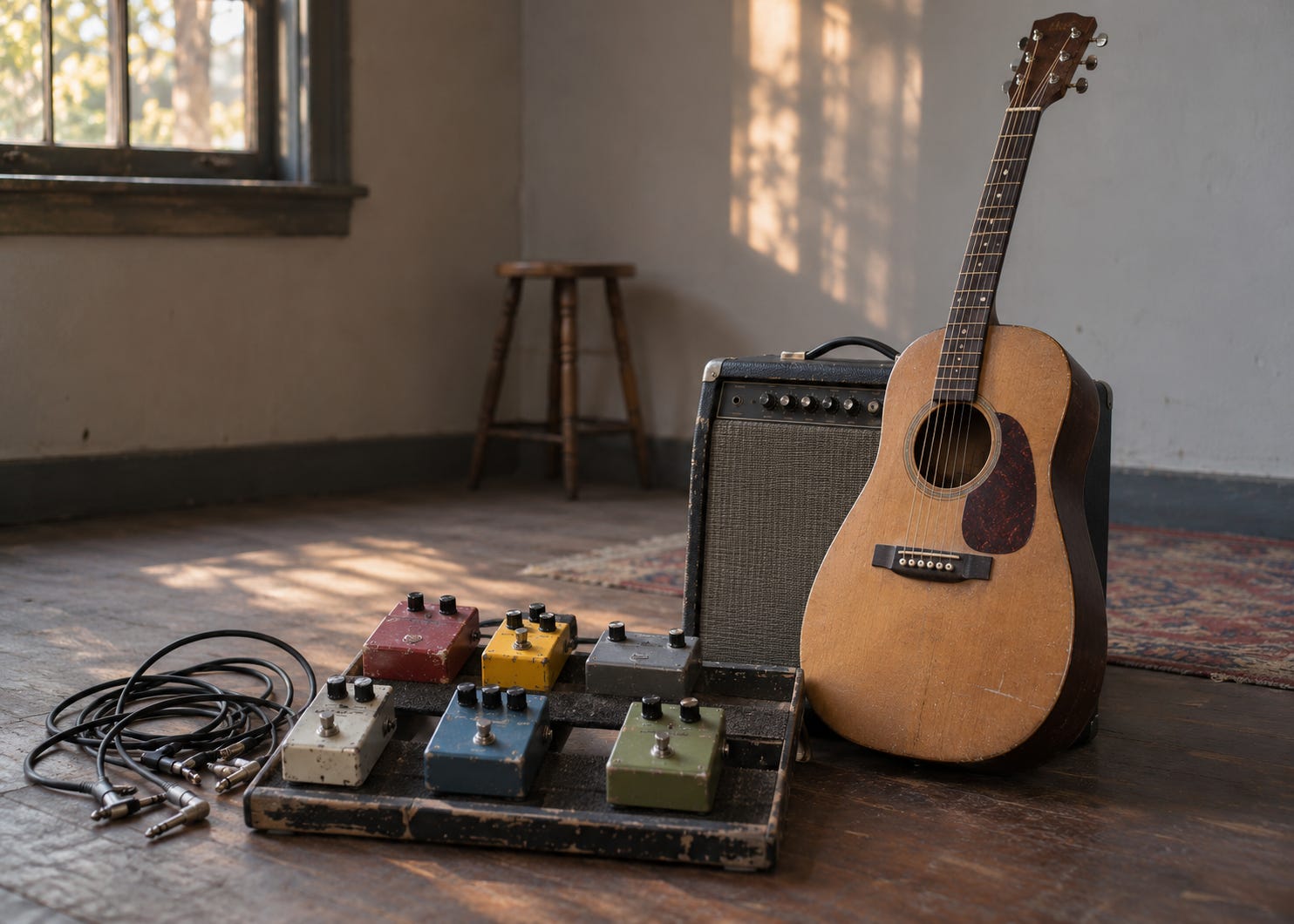
In one of his performances, he plays an electric guitar and conjures that huge, echo-soaked sound from U2’s guitarist, The Edge: the sort of sound that fills the stadium and makes the hair on the back of your neck stand up. But then he says that, really, that’s just all effects. You should really hear what the guitar sounds like without them. The effects drop off, and all you hear is a pretty thin plinking that would barely fill a shoebox. It’s super funny, and the audience falls over themselves laughing. To complete the act, a roadie dashes out on stage, fiddles around with the effects at Bill’s feet, and they kick back in. He finishes on a huge, loud set of guitar chords, the effects fully restored.
I’m really taken with this scene because it made me realise that all too many of us have our own effects pedals turned on. But if you strip away all of that layer, what exactly lies underneath?
It’s like when somebody says, “How are you doing?” and you go, “Great, thanks,” even though that may not be true. We’re all quite likely guilty of dressing things up. Some people might drop their fancy job title early in a conversation or think it’s super important to have a cool car parked in the driveway. Or maybe one of those “how I fought off a shark” stories that gets a bit shinier every time it’s told. Or, when asked how life is, we say, “Oh, so busy,” as if it’s proof of something. Sociologists call it impression management, and none of us is exempt.
I’m certainly not. I’ve written before about being the bloke who filled every silence in a meeting, speaking first and longest so the room would think I was winning, and about men who let their car do the talking for them. I also spent my early twenties doing sound and lighting for shows, mostly in Darwin, and I know how much a smidge of reverb and a well-placed spotlight can do for what’s actually happening on stage.
The trouble with effects in a life, as opposed to on a stage, is that people end up connecting with that polished performance, and every time that version gets a positive response, it makes the authentic you sitting underneath feel a bit less welcome. You can be surrounded by people who enjoy your company and still feel that nobody has heard you, which is about as lonely as it gets. I wrote about that cost in The Quiet Exhaustion of Keeping Parts of Yourself Hidden - it’s the effects rack we’ve turned on that does that hiding.
What keeps the effects rack turned on is the fear of what Bill Bailey was revealing: the suspicion that if all that fancy stuff goes away, what is laid bare underneath will be embarrassing, and people will laugh at us instead of with us.
Interestingly, in 2023, U2 released Songs of Surrender, forty of their songs re-recorded and stripped right back, mostly acoustic, with Pride slowed down and sung low. Talking to Guitar Player about the project, The Edge described the question they started with:
“What happens when you take the band away and you remove from the mix everything we’re famous for? You allow the songs to stand on their own.”
I’m playing that album while writing this article. It’s really interesting hearing those songs, many of which I’ve heard played live at U2 concerts. There’s just the quiet of Bono’s voice, some guitar or keyboards sitting underneath. Bono’s not screaming. It’s almost conversational. You can hear the words individually and make much more sense of the emotion and the message. Whilst U2 live in concert is pretty remarkable, so are these songs. It’s interesting that U2 recognised another layer that could be exposed by stripping away all the set dressing.
Brené Brown, the University of Houston researcher who has spent years studying shame and vulnerability, puts the same idea in plainer terms in The Gifts of Imperfection:
“Authenticity is the daily practice of letting go of who we think we’re supposed to be and embracing who we are.”
I like the word daily in there, because it takes the pressure off. Maybe we each have a group of effects pedals turned on or off. Maybe you switch one off at a time. If you’re in a conversation with someone and they ask, “How are you?” you can answer more authentically without the special effects. Or maybe you don’t drop your fancy job title in the conversation, or maybe tell a smaller version of the shark story at the next barbecue and just let it be enough.