


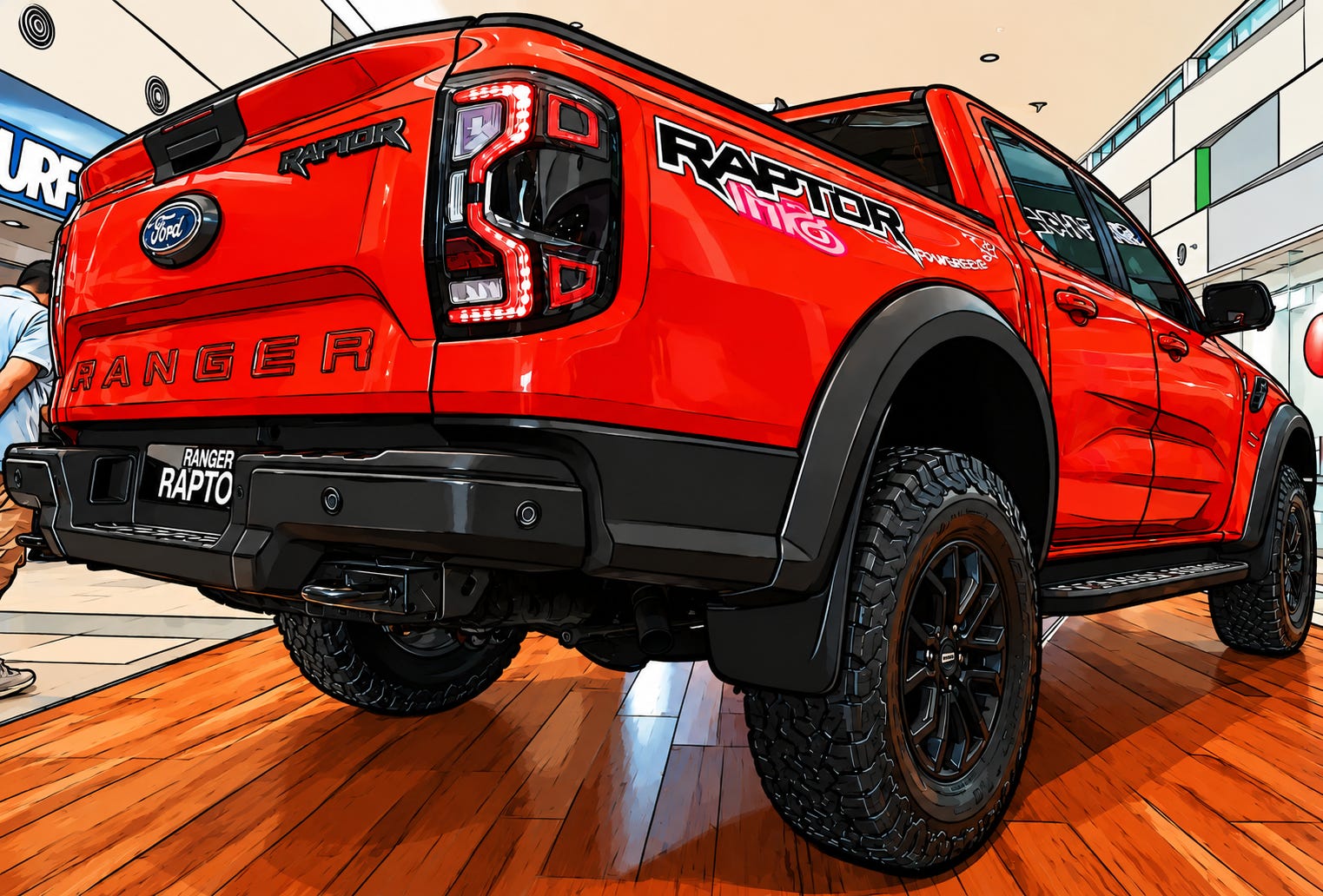
The other day, I was driving behind a HiLux ute with a ‘Rogue’ badge. If you look around on the roads, these kinds of large pickup trucks with gladiatorial names are everywhere.
Australia’s best-selling vehicle in 2025 was the Ford Ranger. Third year running. 56,555 units. You know its variants: Wildtrak. Raptor. You’ve seen its colleagues: the HiLux Rugged X, the Nissan Navara Warrior, the Nissan Patrol Warrior, the RAM 1500 Rebel, the Jeep Gladiator, the Ford Mustang Dark Horse, and the GWM Tank 300.
Say those names out loud. Feel what they’re doing.
They’re not describing the vehicles. They’re describing you, or at least the version of you the marketing team decided you want to be. Independent. Battle-ready. A little dangerous. Not suburban, even when you’re doing the school run.
SUVs and utes now make up nearly 80% of all new vehicles sold in Australia. Passenger car sales are down to 17%. This is not a niche. This is the centre of Australian culture, deliberately constructed around a particular vision of masculinity: armoured, elevated, dominant.
Here’s what those names don’t tell you - and the salesperson in the car yard most definitely won’t.
When a light commercial vehicle and a light passenger vehicle collide, occupants of the smaller car are four times more likely to die. That’s from BITRE, the Australian government’s own road safety body. Not four times more likely to crash. Four times more likely to die in a crash.
For pedestrians, it’s worse. The Insurance Institute for Highway Safety found that vehicles with bonnet heights over 40 inches (which describes most of these utes and large SUVs) are 45% more likely to cause pedestrian fatalities than lower-profile cars. It’s not just the weight. It’s the height. A normal car tends to strike a pedestrian below the hip and roll them onto the bonnet. A Ranger or HiLux hits them in the chest or head and can push them under.
These vehicles feel safer because, for the person inside them, they often are. What the marketing carefully obscures is that a significant portion of that safety is borrowed from everyone else on the road.
That’s the trade. You get the feeling of toughness. Pedestrians, cyclists, and I in my VW Golf pay for it.
The market is selling you emotional safety in the form of physical dominance. It has correctly identified something real: men want to feel capable, protected, and grounded. Those are not shallow desires. They are legitimate needs. The problem is the product. As I’ve written before, we tend to go looking for oranges in a hardware store. A $75,000 ute with aggressive typography on the tailgate is an external answer to an internal question.
Real toughness doesn’t need a name badge. It doesn’t need to sit 40 inches high to feel significant. As I explored in The Quiet Power of True Confidence, genuine confidence is quieter and harder to come by than that. It shows up in the patience you hold when the traffic is bad, the awareness you carry about who is around you, and the way you move through the world knowing your choices have weight.
The Stoics had a word for this: virtus. Strength as an inner quality, not outward performance. You cannot buy it on a forecourt. You cannot lease it for five years.
As I noted in The Quiet Strength Of Being Unsure, Dunning and Kruger’s research showed that the least competent person tends to project the highest certainty. It’s an uncomfortable observation to hold next to a dealership forecourt. The man who genuinely feels capable and grounded doesn’t need the vehicle name to confirm it. The badge is the tell. Certainty you have to advertise is the kind that hasn’t quite convinced itself yet.
The best-selling Ranger in Australia is called the Raptor. It’s named after a predator. Most of the men who drive it are not predators. They’re decent people who got sold a fable about what strength looks like.
I certainly didn't anticipate this article on Substack, but I'm here for this! I cannot even understand why anyone would buy one of these to use it within the city, and nobody can prove to me that these are their only car, especially if they could afford one. Mmm-mmm, no.
As I have a dream to own land and live further away from well-paved roads, I have an intention to own a trusty old Pajero or something for utility, to transport manure and stuff I wouldn't dare to put in my wagon.
Other than that? I'd never.
As someone on the otherside , when the MVA occurred, I don't understand how these are allowed on road.
They terrify me.
They obscure other drivers around them.
So unnecessary in our city.