


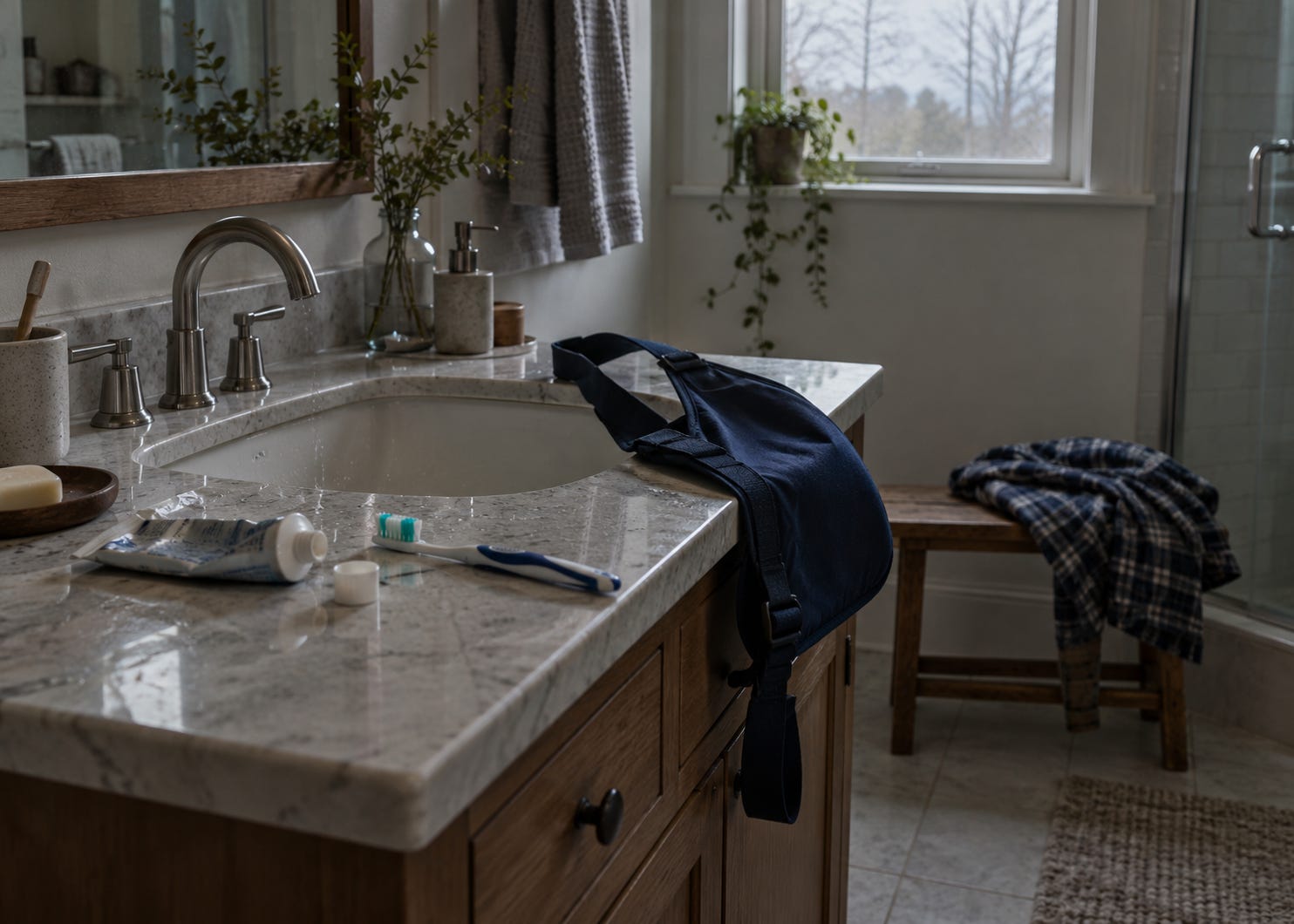
I’m dictating this at my desk in a button-up flannel shirt, pyjama pants and Ugg boots, because getting into jeans and lacing up my boots still hurts more than it’s worth, and I have no reason to go out today. It’s been five weeks since my right shoulder surgery. I’ll try not to make this a whinge, but it has been harder than I expected.
The surgery repaired my rotator cuff, which involved cutting into the top of my bicep and, in my surgeon’s words, hiking it all up, along with some work on the osteoarthritis in the joint. I’m right-handed, and for the first couple of weeks my right arm and hand were close to useless. The hand stayed swollen for more than a week, and only at a follow-up at the orthopaedic clinic at the two-week mark did I learn why. During arthroscopic surgery, they pump a considerable amount of fluid into the shoulder to give the surgeon room to work, and it has to go somewhere afterwards.
Everything I’d handed over to autopilot came back to bite me. So much of ordinary life runs on muscle memory that you never notice it until it’s gone. Cleaning my teeth and using mouthwash left-handed is clumsy, and wiping my bottom turned out to be a skill I had to relearn at sixty. Filling a glass of water, spreading butter on bread and slicing fruit all happen with a hand that has no idea what it’s doing. I can’t keep anything in the right-hand pockets of my jeans, though the sling I bought from Amazon has a handy pocket for my phone and other bits and pieces. I still can’t lift my right arm out to the side, so long drives are out of the question, and I’ve driven the car three times in five weeks when normally I’d drive every day. My standard daily wear is T-shirts, so I had to go shopping for shirts with buttons, and even then getting in and out of them was painful whenever the arm moved more than a fraction. A couple of days ago I managed my first T-shirt.
But the real problem has been sleep. I haven’t slept through the night in five weeks. For the first two or three weeks, I woke every hour and a half or two, sometimes staying up an hour or two before trying again, then dozing in the afternoon. A friend who had the same type of surgery last year warned me she had to sleep sitting up for a fortnight; she wasn’t wrong. Finding a comfortable position in bed was almost impossible, so plenty of nights I’ve slept on the couch, where I could at least lie on my side, with the TV on low until my eyes drooped. I’d wake to find I’d missed an episode or two of whatever was on, which was how I measured how long I’d dozed.
I’ve had chemical help with slow- and fast-release painkillers at night, some of them opioid-based, so I can’t stay on them for long, and they mess with your insides enough that I’m taking laxatives twice a day to stay regular.
The dozes have been getting longer; I only woke twice last night. The first time, about 3:30 a.m., I fell back asleep quickly; the second was at 5 a.m., and I decided to get up. I often wake with my shoulder really aching, I guess a combination of the painkillers wearing off and the shoulder getting into awkward positions while I’m sleeping.
If you’re in the middle of this yourself, you’re not the only one, and the slow days still count even when you can’t see them moving. I write about recovery, resilience and the people who check in on us most weeks. Subscribe to get the next one.
I won’t pretend there hasn’t been comfort food. I don’t usually eat much bread, and I keep pasta and other carbs fairly low, part of a deliberate campaign to drop some weight before the surgery after getting pretty heavy over the last year or two. There has still been a lot of chocolate, and a new love of bacon and cheese toasties.
Some of you might be wondering how I’ve kept writing through all this. Before the surgery I made sure I had a bunch of articles already banked, and in the last week or so I’ve discovered the joy of voice-to-text dictation in Chrome. I can get my right hand onto the keyboard now, but lots of typing is still uncomfortable, so being able to draft by talking at my computer has been enormously helpful, and I wouldn’t have been able to write over the last week or two without it. I’ve also used Claude to help tidy things up, because the dictation, while neat, doesn’t always capture all of my words in the order I say them.
Friends who’d been through the same surgery warned me about all of this, and I did listen and take it on board. It didn’t prepare me for how hard these weeks would be. The improvement comes in tiny daily increments, so someone who sees me week to week notices a fair change, while I’m living it one day at a time and you do get down moments.
I’ve caught myself starting to spiral on a couple of occasions, and I can understand how people end up there. What has interrupted it each time is a text, a phone call or a friend dropping over. I’ve written before about how my close friends banded together around this surgery, so I won’t go back over that ground, except to say they still call and text every day to check in, and I’m forever grateful and in their debt. The hardest part is the one nobody can help with: lying alone in bed in the early hours, my shoulder aching, unable to get comfortable and unable to get back to sleep until exhaustion finally wins.
I went into this fit and strong, after months of work in the pool and at Pilates to get my body as prepared as possible; however, I’ve done no exercise since. I miss the stretching and lengthening work we do in Pilates and the physicality of swimming a bunch of laps each morning.
I’ve been lucky with my health through sixty years. I’ve never broken a bone or had a serious injury or illness, and the worst of it has been very high cholesterol, which is finally back in the normal range after several years of medication. I’d lived with the pain of the damaged shoulder for long enough that I’d stopped noticing what I’d given up, swapping freestyle for breaststroke and kickboard laps so I didn’t have to roll my right arm over, and being careful every time I turned over in bed. I’m conscious that people living with chronic pain face this every single day, sometimes despite everything modern medicine can offer, and my heart goes out to them. My shoulder will get better, given enough time.
I do think I’m more resilient than I realised, physically and emotionally. I’ve had my glum moments, but I’ve stayed as cheerful and upbeat as I can. Today, past the five-week mark, I’m allowed back in the pool, not to swim but at least to get wet and walk lengths. I’m not supposed to put any load on the arm yet, hence the sling, and next Monday I have my six-week review, which I’m hoping clears me to start using it gently. The physio’s notes say real strength training won’t start until three months after surgery, which puts it sometime in December.
DO YOURSELF A FAVOUR
That was Molly Meldrum’s line, and it still holds up. You’re reading Alone Rangers for free, that’s not changing. But a paid subscription keeps it free for everyone else and puts a few dollars behind work that’s trying to say something true about loneliness and connection.