


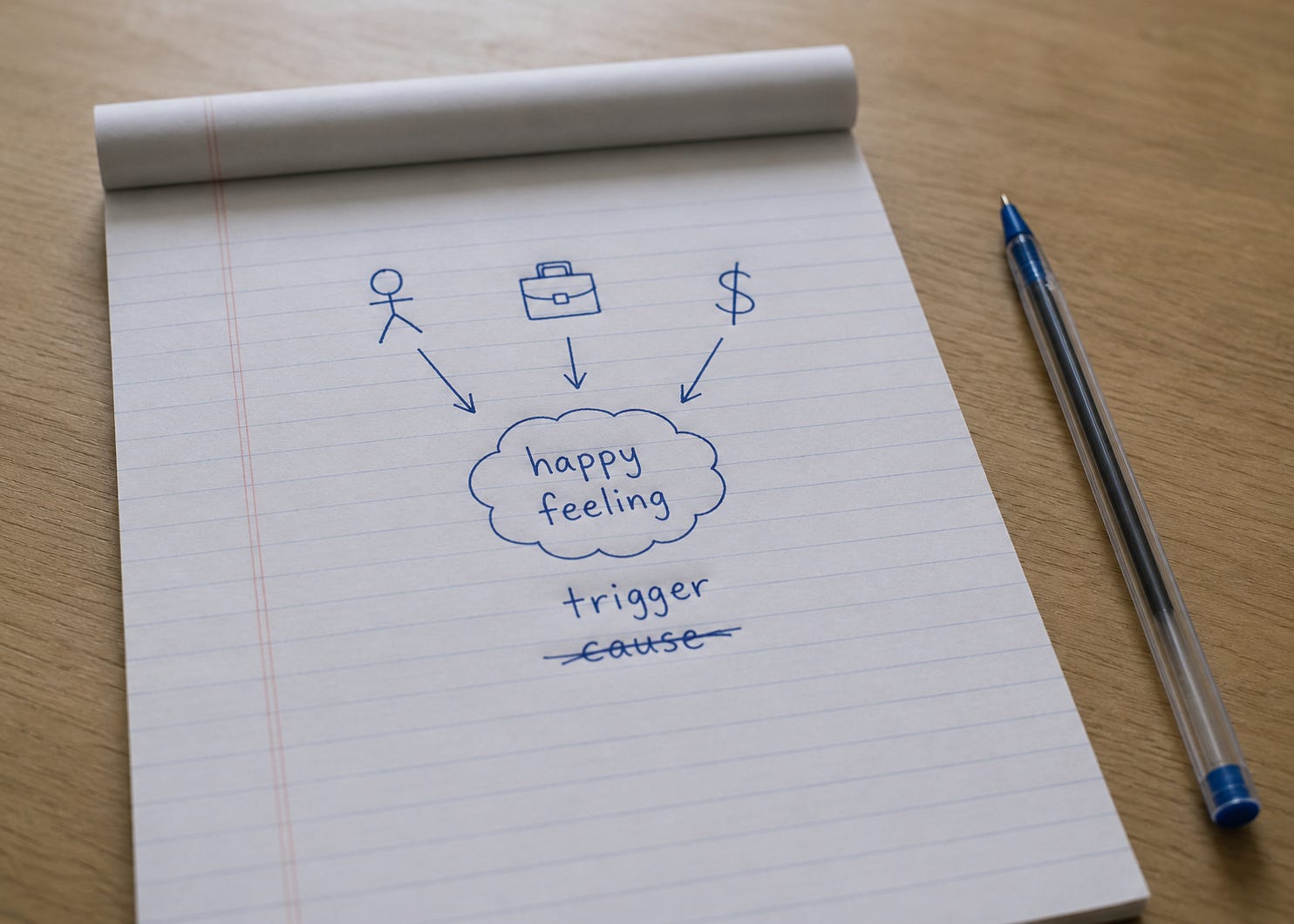
Ask most men what would make them happy, and they will name a person, a job, or a bank account balance. I think it is the single biggest mix-up in the whole subject: treating that person, job or number as the actual cause of the feeling, rather than just the trigger for it. Once you make that mistake, happiness stops being something you build and turns into something you have to go out and collect, over and over, from someone or something else.
The Buddhist teacher Robina Courtin puts the mistake plainly.
“The first mistake is the primordial assumption that the person, the thing or the event is the main cause of the happiness.”
That single sentence from Robina explains a lot of what goes wrong in relationships, but it applies just as well to work, money, and the body you are trying to get back into shape. If a partner is treated as the cause of your happiness rather than its trigger, then losing that partner should mean losing the happiness itself, permanently. Most people who have lived through a break-up know it rarely works that way, however it felt at the time, and most people who have lived through a promotion or a windfall know the lift never lasts as long as they expected either.
Secular psychology supports the same point with data rather than doctrine. The Harvard psychologist Daniel Gilbert, author of Stumbling on Happiness, admitted as much about his own possessions in a recent podcast interview.
“When I think about the things I value in the world, if you take them away from me, I will be utterly devastated forever. The devastated part is right. The forever part is wrong.”
Gilbert has spent thirty years studying what he calls affective forecasting, the practice of predicting how an event will make us feel and for how long. We are usually right about the size of the initial hit. We are almost always wrong about its length, because we underrate how quickly the mind adapts to almost anything, good or bad. A new relationship, a new job title, a bigger house, all of it settles into the background faster than we expect.
I wrote recently about Waiting for Someone Else to Grow Up and reached much the same idea there: my happiness is my problem, not a debt someone else owes me.
When you assume a partner is the source of your happiness rather than one of its triggers, ordinary disagreements start to feel like a threat to your well-being, because you have handed someone else a job that was always yours. You start managing their moods to protect your own, which is exhausting for both of you. The same goes for work, for a body you are trying to get back, for a bank balance you have not reached yet.
Wanting these things is not the problem. The problem starts when you confuse wanting them with needing them to feel alright, because then every setback in that one area threatens the whole thing.
A useful habit is naming the difference out loud when it shows up: is this the cause of how you feel, or just the trigger for it? Most days, remembering that difference is the whole job, and it is one no one else can do for you.