


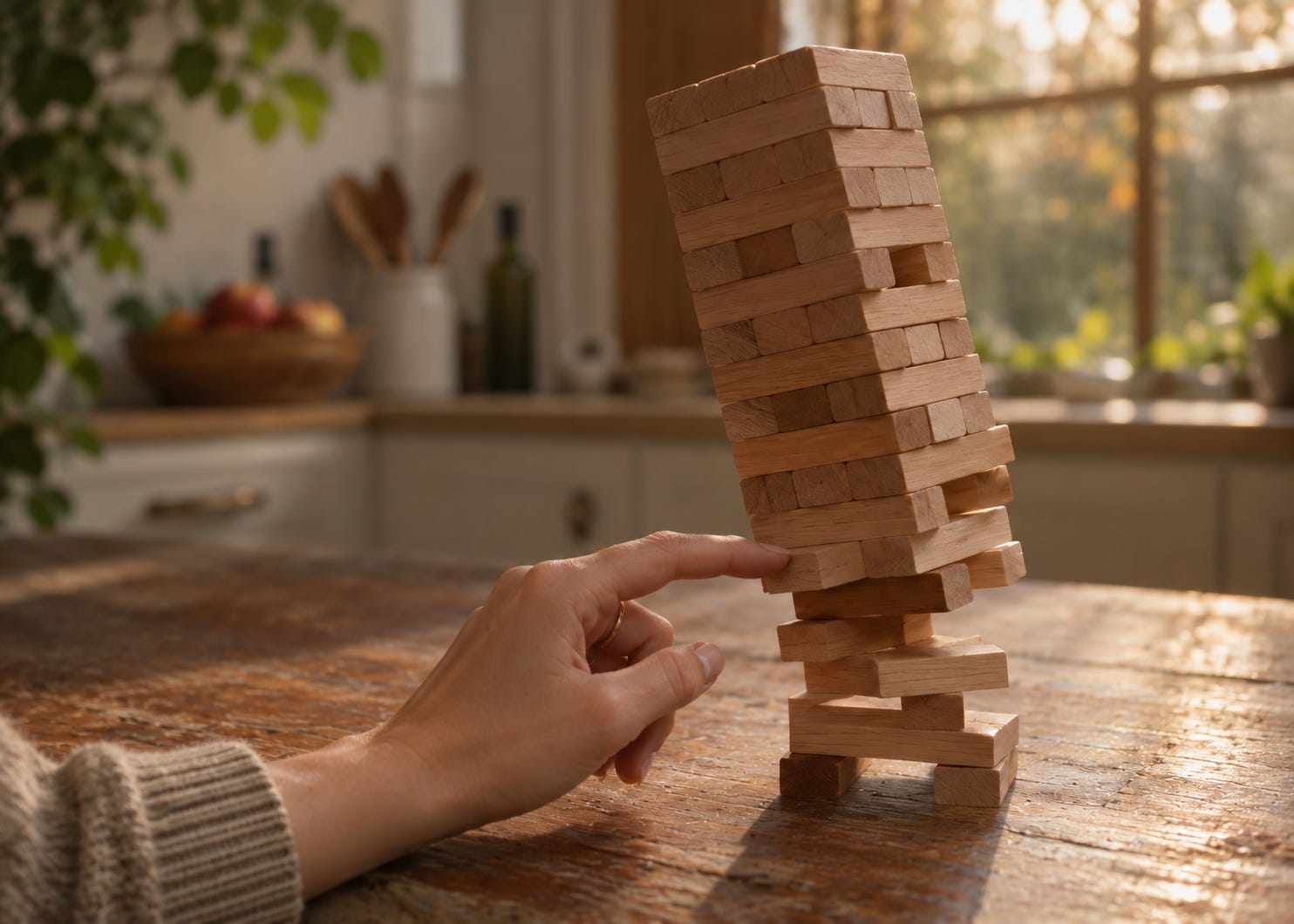
Anyone who has played Jenga knows the moment late in the game when the tower starts to lean, and everyone starts to get a bit silly, and there’s lots of giggling and predictions flying around, and a very close examination of the tower by whoever’s turn it is next to pull a block out. They reach in. Maybe they nudge a block with one finger, very slowly. You wonder whether they’re a moment away from disaster or triumph.
What makes Jenga perhaps a bit cruel and endless is that the tower never gets shorter because every time you pull a block out from lower down, it goes back on top. The structure gets taller and shakier until one little reach and nudge brings it all down.
I was reflecting on this the other day, and I reckon we work the same way. Psychologists call it cognitive load. That’s all the things that our memory, our brain, needs to juggle. We’re spinning plates all the time, waving the little sticks around to keep the plates in the air.
Cognitive load in psychology started as a term around how students learn, but it’s stuck around because it names something most of us actually recognise straight away. Our capacity to spin the plates is finite, so for every plate we spin, or every Jenga block we add to the top of the pile, it all builds up.
Most of us know that if we have too many browser windows open or too many programs running on our computer, our computer slows down and, in some instances, simply grinds to a halt. Sendhil Mullainathan and Eldar Shafir, the economist and psychologist behind the book Scarcity, use the same comparison to a stretched mind:
“By constantly loading the mind with other processes, it leaves less ‘mind’ for the task at hand.”
The difficulty is that a Jenga tower doesn’t always look dangerous, depending on how you’re looking at it. If we’re brave, we think each block we remove and add back to the top won’t cause everything to crash down. We’re just making little iterative changes, even if the lean starts to look precarious.
My connection between Jenga and my cognitive load came after I thought more about the article I wrote the other day, I’m Feeling Glum: When Life’s Small Loads Pile Up, because I was talking through it with a family member who was looking for an analogy for how I was feeling. In the article, I described a whole run of small things, ranging from small to big: surgery on my shoulder, dramas with my car registration. There were things I didn’t even mention in the article: the blown light bulb in my laundry, which I couldn’t change because my right arm was in a sling
Some deeper reflection then helped me understand why, after 11 years, I decided to step away from full-time work at my company. The reality is, since the late ‘90s. I’ve been a co-founder of multiple businesses, a consultant, a contractor, and so on. I’ve never worked long enough for long service leave, for example, that chance to take a break.
I have written before about stepping back, so I won’t retell it here. I think what I’ve learnt from transitioning out of full-time work over the last year or so is how hard it is to make a decision like that before your pile of blocks really does collapse. Perhaps you think your hand is still steady as you pull a block out and put it back on top. Giving up the game can feel like you are going to disappoint people because, on the surface, everything looks okay, even if the reality is that a maelstrom is swirling inside you. I think I was getting really close to my tower of blocks falling down, so I’m glad I made that choice, because I’m not quite sure what it would have looked like if I’d waited too long.
When the tower collapses, the blocks scatter all over the place, across the table, onto the floor, and there’s going to be collateral damage, whether it’s your staff, your family, or your friends.
Greg McKeown, whose book Essentialism argues for doing fewer things properly, puts it this way:
“Only once you give yourself permission to stop trying to do it all, to stop saying yes to everyone, can you make your highest contribution towards the things that really matter.”
I’ve spent the last year living quietly, spending time with my friends and, above all, giving my attention to writing, both here and at Worth Following, the business Substack I launched earlier this year. I’m not sure any of that would have fit on the old tower.
Of course, my Jenga tower never stays short. These past couple of glum weeks prove the blocks keep moving from the bottom to the top. Maybe my point today is to suggest a small habit: every so often, audit everything you’re carrying and decide which block to pull from the tower. Are you going to do it now, or are you going to wait until the game decides it’s time that the blocks fall down?