


For the last few days, I’ve been telling friends I’m feeling a bit glum. I’ve also described my battery level as being about 10%. I think there’s a whole bunch of things contributing to that. I just feel like life is piling one thing after another on top of me, and at some point it’s enough, and the cognitive load can feel overwhelming.
I had the six-week review with the surgeon and physio for my shoulder the other day. I’ve been given some very simple exercises to remobilise the rotator cuff muscles, but also a stern warning to be careful about loading the arm, to give the muscle time to reattach properly to the bone. So, for example, I can’t even use a Theraband for another six weeks. That takes it up to three months of recovery before I can even use a rubber band to really start strengthening all those muscles in my right shoulder.
The shoulder surgery is the first time I’ve really had anything like this happen to me. Other than a small repair on a tendon in my thumb in the late 1990s, I’ve not had surgery or spent a night in hospital. I don’t think I ever realised just how much it was going to knock me around. I’ve written before about letting people take care of me after the surgery and about how much harder the recovery has been than I expected. But then you layer that on top of other things in my life, some of which are really just the everyday load of surviving in the modern world.
For example, the other day I got a letter from VicRoads saying I had paid the registration on one of our two cars twice. After checking, I realised that’s correct. The two cars’ registration plates are only one digit apart because we bought them at the same time, and I paid the registration perhaps two weeks after my surgery, when I really was in a brain fog, what with pain drugs and the exhaustion of not being able to sleep properly at night.
I haven’t really been driving very much recently, obviously, but my arm has been more mobile and useful over the last week, so I have been venturing further afield than just a quick run up the road to the shops. But of course, the double payment means I’ve been driving my car, which I didn’t double up on, unregistered for a month. In Victoria, police cars have number plate scanners, and it’s entirely possible I could be pulled over by the cops. Whilst I have a very legitimate reason for the non-payment, or what looks like a non-payment, the reality is they’re still going to fine me a very considerable amount of money.
I finally connected the dots the other day and called VicRoads. I have to say, the woman who looked after me was fantastic and lighthearted, and she made the point that this happens all the time with families who have multiple cars with registrations that come up for renewal at the same time. I’ve paid the registration on my car, which means I’m legal again and don’t have to drive around panicking, and they’ll organise a refund to me of the double payment on the other car.
But it’s taken time to sort all of this out, and it’s cost me more money, because I’ve had to pay yet another registration fee while I wait for the refund to come back.
If you're in the middle of this yourself, you're not the only one, and plenty of us are running on a low battery without telling anyone. I write about solitude, friendship and the inner life of men most weeks. Subscribe to get the next one.
There’s also the minor detail that I’m only two points away from losing my licence for three months. In Victoria, you lose points for various traffic offences, and once you lose 12 points you automatically lose your licence for three months. It’s all down to red light cameras. For those of you not familiar with them, or who don’t have to live with them, these are road safety enforcement cameras that check whether you’ve run a red light. The infringement notices even tell you how many seconds late you ran the light, and for mine, the longest was 0.6 seconds into the intersection. A red light camera fine incurs three points, and I’ve had one per year for the last three years. I absolutely remember one of them. It was a dark night, very late, raining heavily, with not much other traffic around, and the lights were changing to yellow. I decided not to brake hard because of the conditions, and as a result I crossed the line a fraction of a second after the red light came on.
Those three fines total nine points. The tenth was a low-range speeding fine, 56 km/h in a 50 km/h zone. It was 1 am, an unfamiliar road, no other traffic around, and I missed that the road transitioned from 60 km/h to 50 km/h. That’s one point, hence a total of 10.
I do consider myself a reasonably safe and careful driver. I try not to do anything stupid; I follow the speed limit and take care. Indeed, one thing that triggers emotion in me is seeing the appalling behaviour of many drivers. Indicators, for example, seem to be an optional extra on many cars these days!
By May 2027, the three points from the first red-light fine should fall away, as points last for three years. But of course that means I’m driving on tenterhooks until then, because losing my driver’s licence would be a very significant impingement. So I have another cognitive load issue to deal with.
There have been a few other things like this recently, adding up to a year of some degree of uncertainty. Things are moving in the background that make it difficult for me to plan my future and work out where I want to live and how I want to live. So I think I’ve been on edge much more than I realised, with a sort of subtext running underneath my life that I’ve tried not to allow to surface too much, because it can bring me down. I don’t have a solution, and I don’t have certainty. I suspect a considerable proportion of the population are in the same position as me.
The Australian Unity Wellbeing Index, which surveyed more than 10,000 Australians in June 2025, describes the conditions plainly:
“It took place amid a cost-of-living crisis, ongoing global political and economic unrest and natural disasters at home and abroad.”
Of the seven parts of life the survey measures, future security scored lowest, which tells me I’m not the only one finding it hard to plan.
I also think that I’m getting a bit more depressed than usual about the state of the world. I read the news, I scroll social media, and I watch the political shenanigans, obviously in the USA, but also here at home in Australia. I also watch, notice, or hear about people’s behaviour on the street, out and about, and some days I feel quite sad about the world we live in. I don’t think there’s any one particular individual thing, more a conflation of many.
I’ve mentioned in a previous article watching the Louis Theroux documentary Manosphere. Quite clearly, anybody with half a brain would watch the men in that documentary and feel disgust. But I also saw an Instagram reel the other day with an Australian man talking about the manosphere, and he was very clear that he disagrees with, for example, the behaviour of the Tate brothers. But he made an important point: young men respond to this messaging because it connects directly to how they feel and how they see their place in the world. And so it should offer us clues to what ails our community, when that community finds itself in such a state that young men respond positively to such misogynistic, divisive messaging.
There are some other things in my world which I probably don’t need to be sharing today, but the point I think I’m making is that the six or seven weeks I’ve had feeling miserable after my surgery have so depleted my energy banks that all the other irritations of life have been set in relief and given more prominence in my subconscious. That’s why I’ve been telling some friends I’m feeling glum.
Saying it out loud is harder than it sounds. The Ending Loneliness Together State of the Nation report found:
“Nearly 1 in 2 Australians who feel lonely are too embarrassed to admit it to others”
Glum isn’t the same as lonely, but I suspect the same embarrassment stops plenty of people from saying anything at all. One of the great things about the people around me is that they won’t patronise me by holding my hand and telling me it’s all going to be okay.
Australian social researcher Hugh Mackay put it simply:
“We are not good at surviving in isolation.”
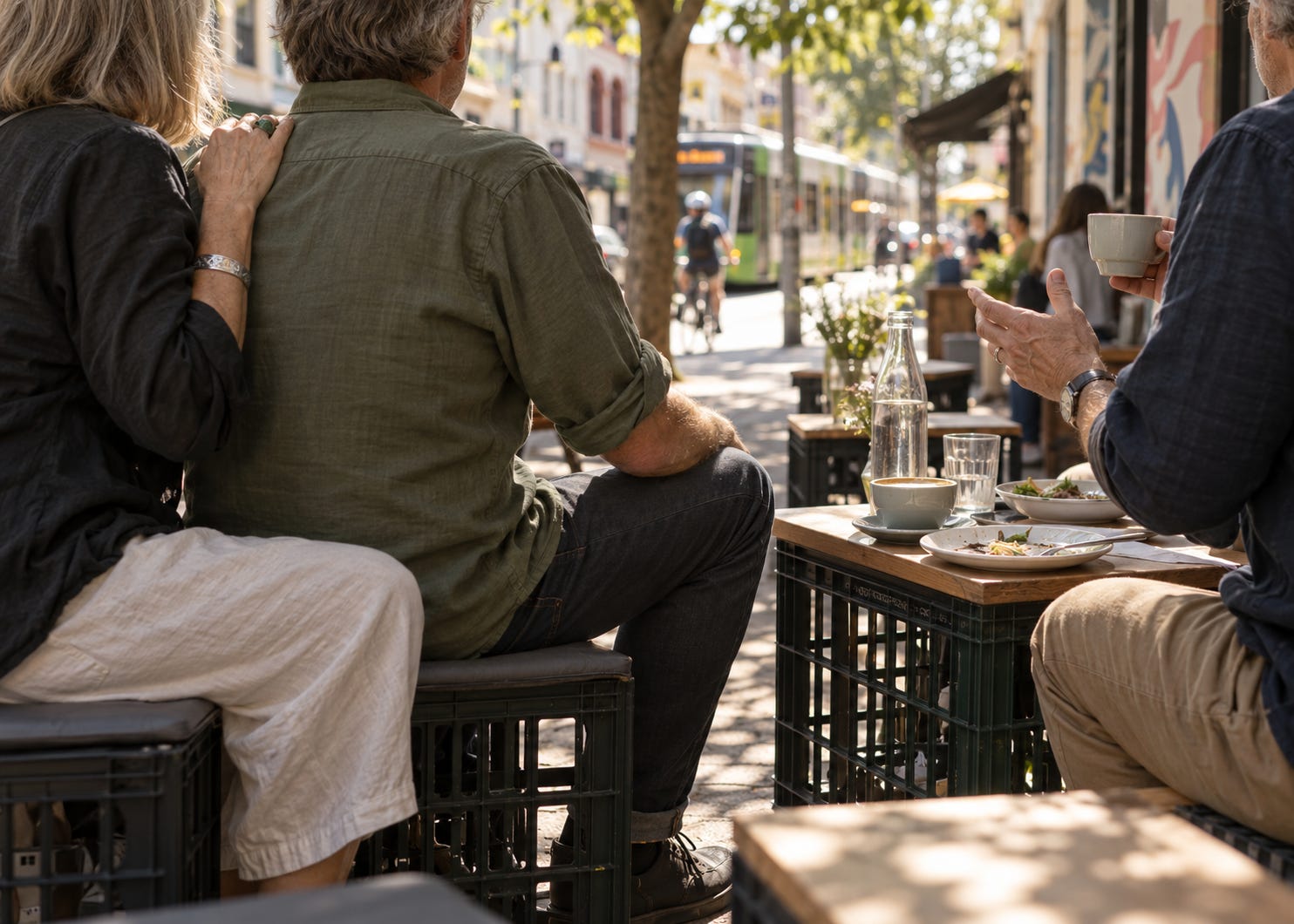
My friends turn up. They make time to be with me, and they give me hugs, because touch is important. The other day I had lunch with a couple of them out on the street on a lovely, warm, sunny day, and we talked about all sorts of different things. They showed sympathy for how I was feeling, and they didn’t try to tell their own stories. Instead, they listened to mine, which I think is very important. Those small, simple things are enormously restorative.
DO YOURSELF A FAVOUR
That was Molly Meldrum’s line, and it still holds up. You’re reading Alone Rangers for free, that’s not changing. But a paid subscription keeps it free for everyone else and puts a few dollars behind work that’s trying to say something true about loneliness and connection.