


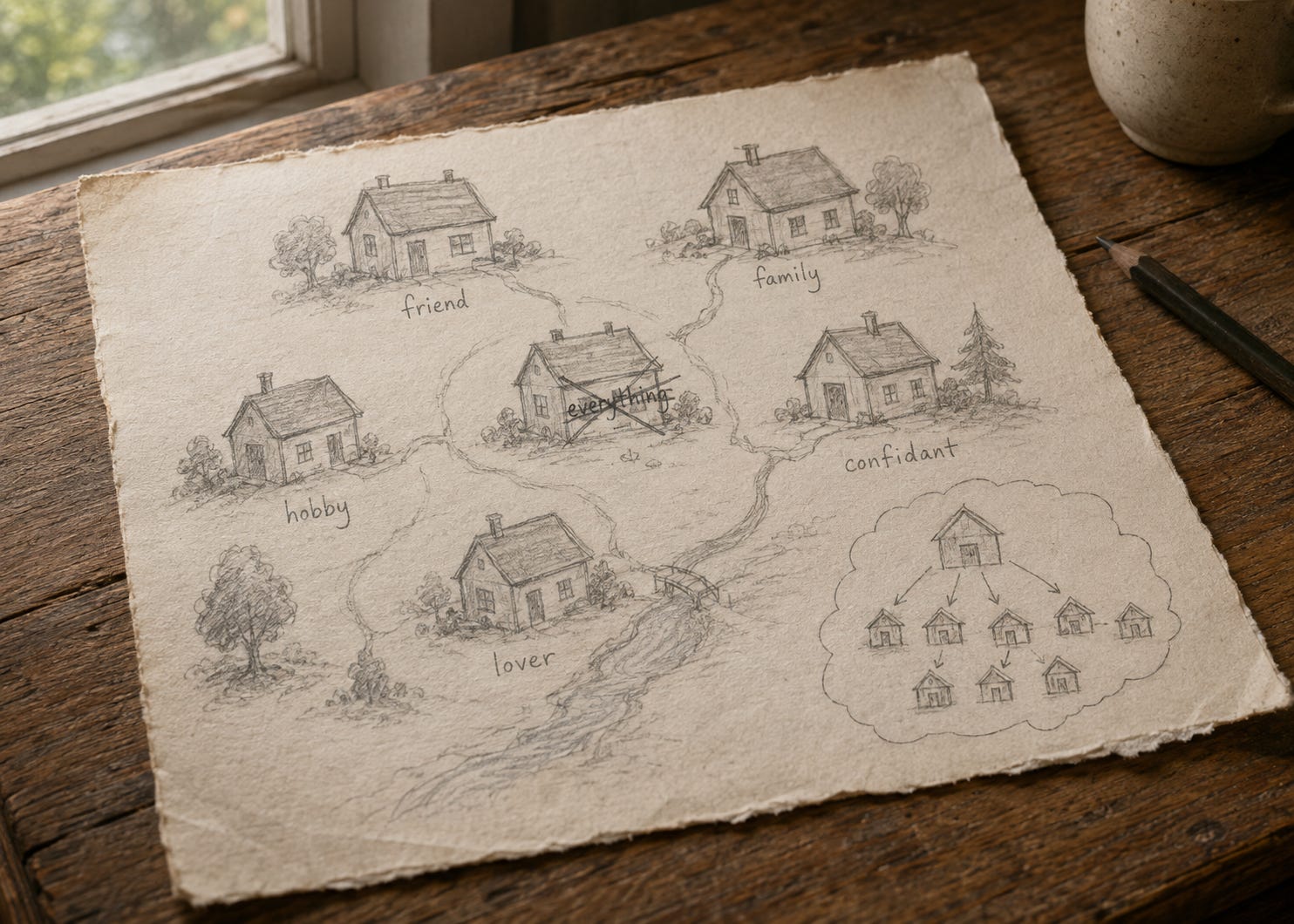
I’m not great at weddings. There are so many tropes bandied around - he’s not just my husband; he’s my best friend. She’s not just my wife; she’s my whole world. And all that “in sickness and in health til death do us part” really rubs me the wrong way. I know it’s meant as praise, as a heartfelt expression of how the happy couple feel about each other. But if you strip away the flowery language, what’s actually being asked of the two people standing at the altar is that they will provide each other with the equivalent of a support network that once spread across a village, an extended family, or a whole street of people. Especially today, those external supports often simply don’t exist in our Western cultures.
I have written before about the fantasy of expecting a hardware store to sell you oranges, the frustration of walking into a relationship wanting those tropes, but coming out with a shifting spanner and a reciprocal saw, then blaming the shop for not stocking oranges. In that article, I concentrated on accepting what an individual was actually built to give you. But I wanted to dig a bit deeper: even in a relationship that mostly is working, how can one person ever be expected to supply everything a human being needs?
Esther Perel has spent a career answering that with a fairly blunt no. In her TED talk The Secret to Desire in a Long-Term Relationship, she names exactly what modern couples ask of each other.
“So we come to one person, and we basically are asking them to give us what once an entire village used to provide: give me belonging, give me identity, give me continuity, but give me transcendence and mystery and awe all in one. Give me comfort, give me edge. Give me novelty, give me familiarity. Give me predictability, give me surprise.”
If you look down Esther’s list, it looks like a heck of a job description; the only thing missing, although I reckon it’s implied, is “any other duties as directed”! Is it any wonder so many couples find that the actual job seems so much harder once they are hired? It’s not because either is inadequate, but because the role was never built for just one person. For most of human history, it wasn’t. Elders, siblings, neighbours and the wider extended family absorbed different pieces of what we now expect a single spouse or partner to carry alone. The nuclear household that replaced all of that for many of us is, historically speaking, a recent invention, and a container that struggles to hold a very large set of needs.
Historian Stephanie Coontz has spent decades studying how marriage changed, and she put the modern version of the problem plainly in an interview with Greater Good magazine.
“The healthiest families are those families that don’t try to be everything and do everything.”
When a relationship says you need to be a best friend, a lover, a co-parent, a therapist, a cook, an exercise partner and a financial planner, is it any wonder so many relationships buckle under the workload - and when it is not acknowledged, the resentment on both sides builds until something inevitably gives? Meanwhile, both sides wonder why the whole dream is falling apart, when, and I really hate to say it, the whole endeavour was set up to fail in the first place.
I want to make it clear: none of this is about loving someone less; rather, we need to acknowledge that we might need to build a wider circle around that love. It could be close friendships, a chosen family, a non-monogamous network, or simply admitting that your partner doesn’t have to be your gym buddy, your therapist, and your only confidant; the shape isn’t the point. What matters is working out which needs are truly load-bearing for you: safety, honesty, respect, and which ones you have been quietly outsourcing to one exhausted person.
Some might see this conversation as evidence that a single relationship is not enough, indeed, that needing others in your life is a betrayal of the one you walked down the aisle with. But I think it is the opposite: if your partner does not need to fulfil the whole role description, they have space for the parts of you they are actually suited to. Think of it as job sharing! And thus you stop mistaking a hardware store’s stock limitations for your or your partner’s limitations.
When a partner disappoints you, it is rarely proof they do not love you enough. More often, it proves you handed them a role built for several people and never got around to telling anyone else they were needed too.
Read more like this
Maybe One Person Was Never Going to Be Enough
Is Monogamy the Only Grown-Up Way to Love?
Loneliness in Relationships: When Being With Someone Isn’t Enough
DO YOURSELF A FAVOUR
That was Molly Meldrum’s line, and it still holds up. You’re reading Alone Rangers for free, that’s not changing. But a paid subscription keeps it free for everyone else and puts a few dollars behind work that’s trying to say something true about loneliness and connection.