


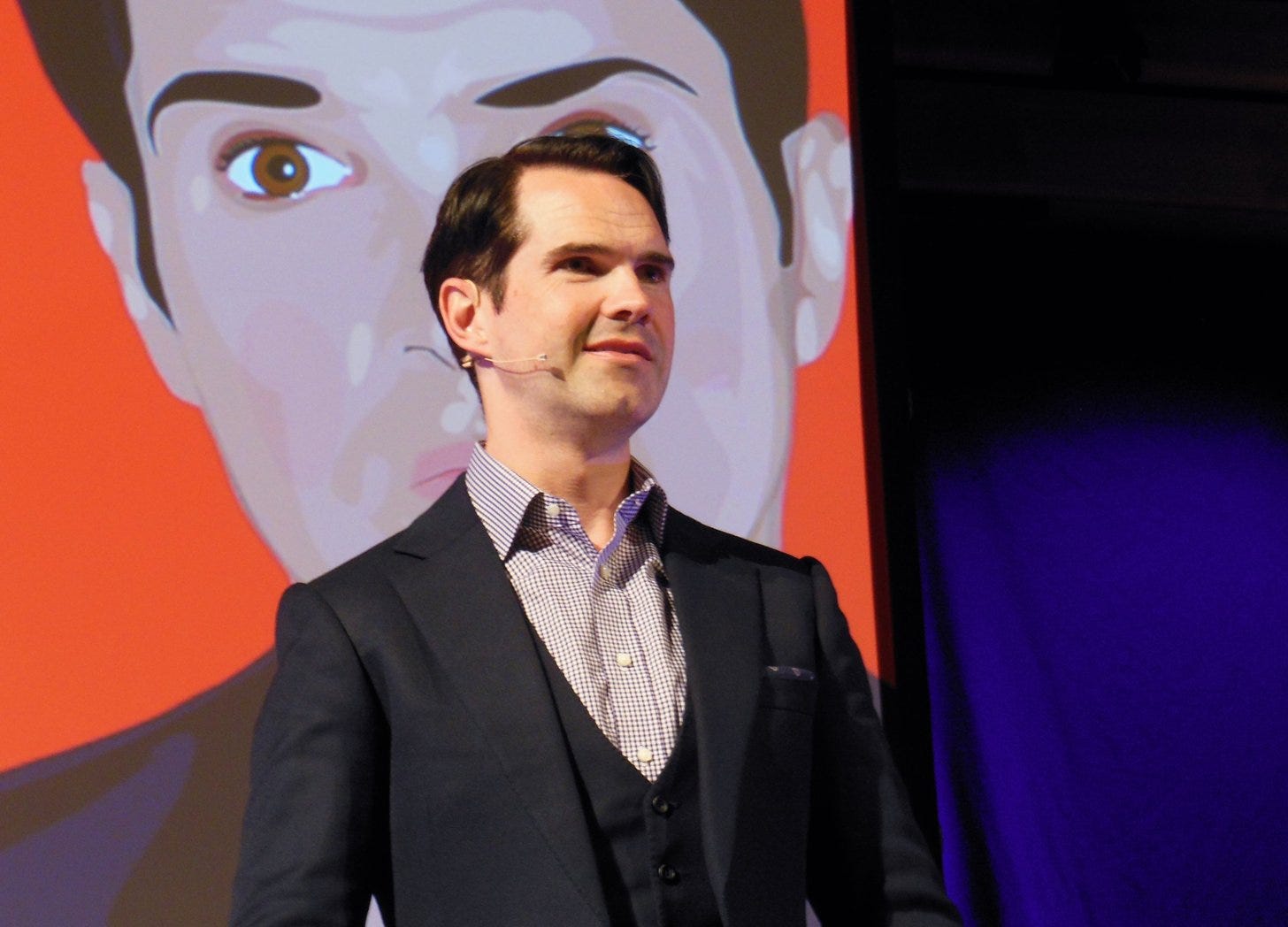
A man stands up at a Jimmy Carr show and asks how Jimmy keeps his mental health in check when he’s on tour. Jimmy doesn’t reach for the joke; he reaches for the man:
“Are you suffering at the moment? You okay, mate?”
And the audience member replies:
“I’m divorced and, like, you’ve been really great for me.”
A bloke has spoken up about his divorce at a comedy gig and stood up in a room full of strangers to tell a man on stage, someone he has never met, that he’s been great for him. Perhaps this wasn’t something he could say to a mate over a beer - or indeed, he may not have a mate he could say it to. So he spoke up, in the dark of a large auditorium, to a very public figure who is known for often suspending the comedy to speak seriously about mental health. And the guy dressed up his own welfare as a question about Jimmy’s, knowing full well Jimmy had a laugh available as an exit if it all got too much.
I understand that man completely, because for most of my life that was the only way I knew how to do it too. I’ve written before about how men lose the venues and the tools for saying the hard thing out loud, and here was a man using the one venue that felt safe enough: the audience.
Carr’s answer was better than most of what passes for men’s mental health advice. It deserves quoting properly.
“Well, look, I think a lot of the time we get hardware and software mixed up. I think a lot of the time you think, like, ‘I think I have a mental problem.’”
“Firstly, it’s like depression and anxiety, it’s much better to say sad and worried. Sometimes the less medical language makes it feel more manageable.”
“And the other thing is, I think: how many of our mental problems are actually physical problems, right? If you’re getting eight hours’ sleep a night, and you’re exercising and walking in nature every day, and eating real food with real nutrition in it, if you do that for a week, let me know where you are after that. It’s a hardware problem.”
We decide we’ve got a software fault, something wrong in our thinking that needs therapy or medication or a complete personality rebuild, when the machine has been running on four hours of sleep, no daylight and food that comes in a takeaway container.
Jimmy’s right - for many people struggling with low-grade misery, decent sleep, regular movement, some sunlight and real food will shift things more than any amount of introspection. It isn’t glamorous advice, but it works.
If you’re in the middle of this yourself, you’re not the only one. I write about men, loneliness and the friendships that keep us going most weeks. Subscribe to get the next one.
Jimmy didn’t stop there either, and that’s the part the clip-sharers tend to trim. He looked at a divorced man and named the loss for what it was:
“that was a woman that you loved, and you planned something together, so there’s a grieving to that. Just be as kind as you can be.”
No question Jimmy Carr is a remarkably talented performer, but he’s also a deep thinker - it’s worth searching for interviews and podcasts about him. He’s not just a well of one-liners; he’s well read and has clearly thought deeply about a range of mental health issues. And that was evidenced in the exchange with the audience member - in what passed as ‘crowd work’, he checked on the person, offered the hardware v software as a solution, honoured the loss of the man’s relationship and topped it all off with kindness. I doubt many of us could do that so effortlessly, let alone in front of a packed theatre crowd who’ve paid to come hear jokes.
Unknowingly, I’ve actually been following Jimmy’s advice. I did the hardware work properly in the lead-up to my shoulder surgery. I’ve lost more than 13 kilos, I swam laps multiple days a week, and I really focused on my Pilates. My cholesterol has finally been brought down to something a doctor can look at without wincing, and my kidney results are back in a healthy range, so the machine runs better than it has in a long while.
But I do think Jimmy’s list needs another item. The late neuroscientist John Cacioppo spent his career showing that loneliness is a biological signal, the same kind of primal alarm the body sounds for hunger and thirst, which means your body treats a lack of people much the way it treats a lack of food.
“I like to use the analog of hunger... Loneliness is very much like that, and instead of sustaining us with calories, it sustains us with connections.”
So alongside sleep, exercise, nature, and real food sits a fifth item: people. I’d put it on the hardware list too. We tend to file connection under software, a nice-to-have we might install once life settles down, when it’s much closer to nutrition and part of what the machine actually runs on.
I think that reframe matters for men in particular. Men will schedule maintenance; we service the car, do the gym reps, and take the supplements, because maintenance is measurable. Add human connection on the list, and it stops being an emotional confession and becomes something you just do with the discipline you’d bring to the gym, whether that’s a text, a beer you book in, or a call on the drive home.
I think Jimmy is right that reaching for clinical language too early can make a feeling seem bigger and more permanent than it is. My problem at 54 was that I had no words at all. It took therapy, and a therapist who wouldn’t accept my shallow answers, before I could name what I was feeling with anything more precise than ‘fine’.
I do want to be clear - sometimes it really is depression, and a week of walking in nature won’t fix it. If the dark doesn’t lift, you must go and see someone, because that’s hardware maintenance too.
The man in the audience got more great advice than many men get in a year. All credit to Jimmy Carr; that was a good human at work. But a comedian on tour can’t be the man’s plan, because the gig ends, the lights come up, and everyone heads home. The fifth item is the one only the rest of us can supply.
So this week, try one piece of connection maintenance and give it the diligence you’d give a workout, whether that means sending the text or booking the beer. And be as kind as you can be, including to the bloke asking a comedian for help, if that bloke happens to be you.
DO YOURSELF A FAVOUR
That was Molly Meldrum’s line, and it still holds up. You’re reading Alone Rangers for free, that’s not changing. But a paid subscription keeps it free for everyone else and puts a few dollars behind work that’s trying to say something true about loneliness and connection.
Really well done David and you're exactly right about Jimmy Carr. Thanks for this perspective.