


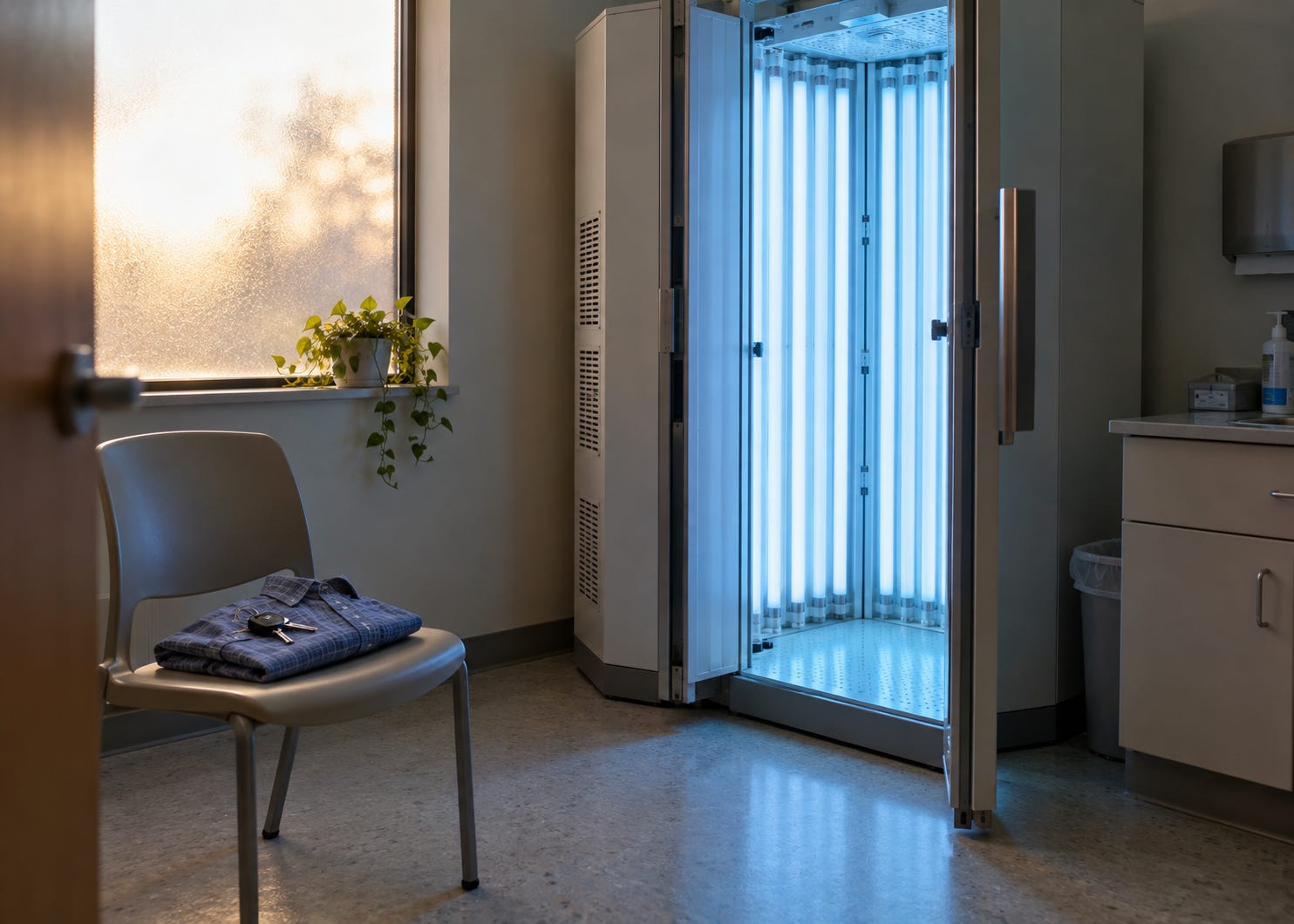
For several months, towards the end of my long-term relationship, I made quite a long drive across several suburbs to stand inside a solarium-type machine. It was a sort of cylinder of what I guess were fluorescent tubes, and you started slowly, maybe only a minute, then built up gradually until you were in there for ten minutes. The idea was that this phototherapy would treat a really awful case of psoriasis on my chest, very itchy and horrible. The whole thing was all a bit odd.
There was considerable stress between my partner and me at the time, and we had already started talking about not being together anymore. We were also running a business that was only a few years old, money was very tight, and we had three children at school, so there was an awful lot going on. This was before I’d had any therapy. Apart from telling my partner I was off to the doctor, I didn’t tell anyone about it. I had absolutely no friends or people I felt comfortable having that conversation with, so I suffered in silence, and that only made it worse. It became a closed loop: the less I talked about it, the worse the stress got, and it fed on itself.
With my doctor, I think I just called it stress, the stress in my life, without breaking it down any further. I don’t know that I even understood I was lonely. I knew I was incredibly unhappy, but that had been my whole life. Stress is a recognised trigger for psoriasis flare-ups, so it was a fair thing to raise, but it left out a great deal.
The psychologist Susan David, author of Emotional Agility, described the habit in her TED talk:
“We often use quick and easy labels to describe our feelings. ‘I’m stressed’ is the most common one I hear. But there’s a world of difference between stress and disappointment or stress and that knowing dread of ‘I’m in the wrong career.’”
I was using one word to cover a relationship coming to an end, a young business, money that was very tight and three kids to raise, and underneath all of that I was lonely without knowing it. You can’t tell your doctor about something you haven’t recognised in yourself.
Back in March I wrote The Language Men Never Learned, about why so many men struggle to talk about loneliness, and one line from it applies to me as much as anyone:
“We men all too often don’t even have the language to start the rebuild.”
Realising I was lonely was the big revelation, and it came a year or two after those drives across town. The language problem itself was rammed home to me when I started therapy after my relationship ended.
The neuroscientist Lisa Feldman Barrett calls the ability to tell one feeling from another in fine detail emotional granularity, and in her book How Emotions Are Made she links it to physical health:
“People who exhibit higher emotional granularity go to the doctor less frequently, use medication less frequently, and spend fewer days hospitalized for illness.”
I’m not about to claim that a better word would have cleared up my skin, and I’d be wary of anyone who did. I do think “stress” was too broad to be much use to me. It described my whole life at that point, and nobody can do much about a whole life in one appointment, whereas loneliness is something a phone call or a coffee with a mate can start to shift.
It also makes me wonder whose job it was to dig further. My doctor at the time didn’t have that conversation with me, and the research suggests it was worth having. A 2022 review in General Hospital Psychiatry found people with psoriasis are 1.5 times more likely to show depressive symptoms, and recommended that doctors screen all their psoriasis patients for depression and anxiety. Loneliness is trickier to ask about. Johanna Badcock, a clinical research psychologist and vice chair of Ending Loneliness Together, explained the recommended approach to GPs:
“The current recommendations are to use indirect assessments and approaches that don’t explicitly use the word loneliness. For example, ‘Do you feel there are people around you who really know you and understand you? Do you feel in tune with the other people around you?’”
If anyone had asked me the first of those questions back then, I would have said no. I don’t want to be too hard on a GP looking at a skin condition while the patient talks about stress, because appointments are short and I gave them very little to go on.
So if you hear yourself telling a doctor, a partner or a friend that you’re stressed, ask yourself what the stress is actually made of, even if you only answer that question privately at first. One more specific word gives you, and them, something to work with.
Back then I couldn’t have told my doctor I was lonely, because I didn’t know it yet. These days I have a different doctor, one who has asked me more probing questions from time to time and has made me very comfortable being open about emotion, which I’m very grateful for. Between that and everything I’ve learned since, I’m far better equipped to have an open and honest conversation, and if I were in that first appointment now, I’d be able to say what the stress was made of.
DO YOURSELF A FAVOUR
That was Molly Meldrum’s line, and it still holds up. You’re reading Alone Rangers for free, that’s not changing. But a paid subscription keeps it free for everyone else and puts a few dollars behind work that’s trying to say something true about loneliness and connection.